


- INDOOR LIGHTS
- 360 Degree Neon Customised Lighting
- Magnetic Track Lights
- Skyline Steel Strip Lighting
- Chandelier & Pendant
- Down Lights
- Bulbs
- Surface Mounted Lights
- Led Rope Light
- Led panels
- Cabinet & Wardrobe Lights
- Led Tube and Batten Lights
- Linear Hanging & Recessed Bar Lights
- Track Lights
- Wall Lights
- Fibre Optic Ceiling Lights
- Lamps
- OUTDOOR LIGHTS
- SOLAR LIGHTS
- Disco and Party Lighs
- Led Addressable Lights & Controllers
- Fibre Optic Lights
- Stretch Fabric Ceiling Light
- Silicone Profile Light
- Led Strip Lights
- Led Aluminium Profile
- Led Adapters & Power Supplies
- Customized Lights
- Led tree Lighting and Decoration
- OTHER PRODUCTS

💡 The Ultimate Guide to Lighting: Every Type, Space, and Purpose (2026 Master Edition)

Last reviewed: 2026 | Technical review: Newon Design & Engineering Team
Reading time: 28 minutes | Target Audience: Architects, MEP Engineers, Lighting Designers, Facility Directors, and Homeowners.
The Editorial Thesis: The strongest lighting design does not begin with a list of fixtures; it begins with the job the light must perform. Lighting must help people see a task, move safely, notice a product, feel comfortable, read faces, create atmosphere, or capture images. The correct solution connects four layers: Source (LED, discharge), Optics & Fixture (beam, shield, diffuser), Space & Task (room, workplace, canopy), and Control (dimmer, sensor, scene). For complex projects, Newon can combine lighting design and installation services with products, controls, and commissioning. Sufficient illuminance alone is not enough; good lighting depends on glare, color quality, surfaces, and application.
Jump to Room Calculator | Browse Newon Lighting Products | Request Professional Photometric Design
1. The Physics & Fundamentals of Light
To specify lighting correctly, you must understand the metrics that govern human visual perception and energy consumption.
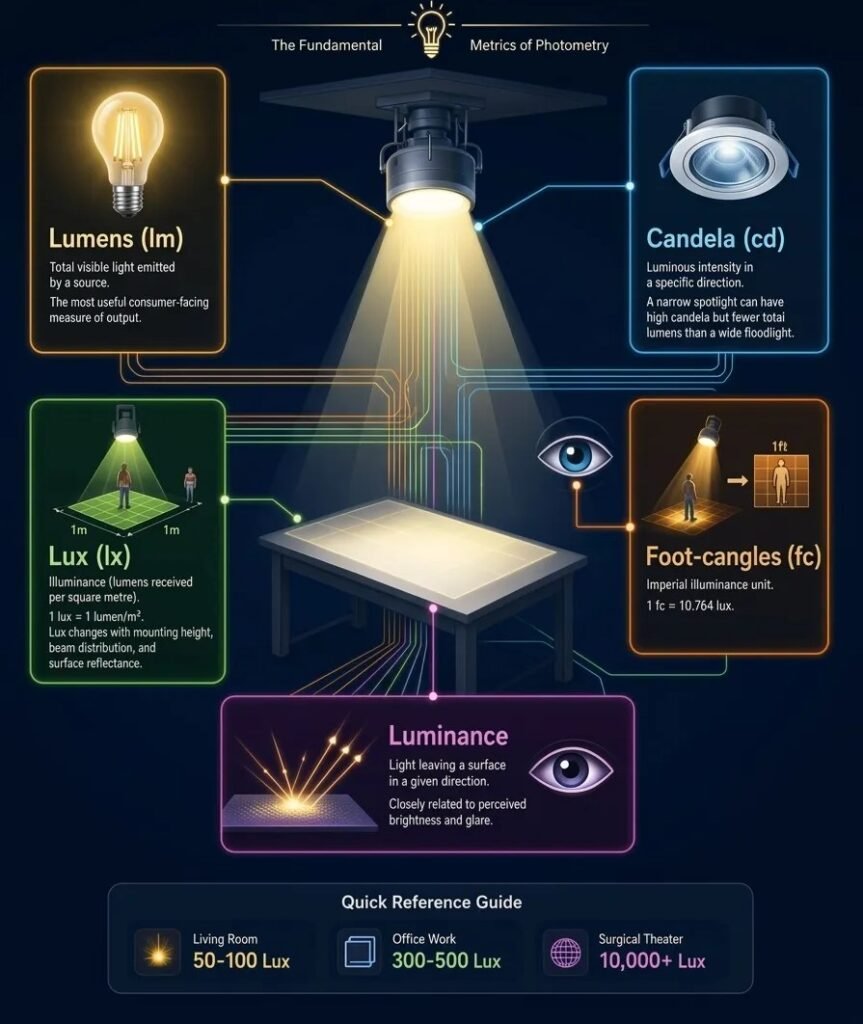
1.1 Lumens, Lux, Candela, and Luminance
- Lumens (lm): Total visible light emitted by a source. The most useful consumer-facing measure of output.
- Lux (lx): Illuminance (lumens received per square metre). 1 lux = 1 lumen/m². Lux changes with mounting height, beam distribution, and surface reflectance.
- Foot-candles (fc): Imperial illuminance unit. 1 fc = 10.764 lux.
- Candela (cd): Luminous intensity in a specific direction. A narrow spotlight can have high candela but fewer total lumens than a wide floodlight.
- Luminance: Light leaving a surface in a given direction. Closely related to perceived brightness and glare.
1.2 Watts Are Not Brightness
Watts measure electrical power, not visible output. A modern LED produces the same light with up to 90% less power than an incandescent lamp (ENERGY STAR). Buyers must compare lumens, lumens per watt (efficacy), color quality, and distribution, not just wattage.
1.3 Efficacy: Source vs. Luminaire vs. System
- Source Efficacy: Output of the raw LED chip (lm/W).
- Luminaire Efficacy: Output of the complete fixture divided by input power (accounts for diffuser/driver losses).
- System Efficacy: Delivered useful light after optics, controls, and thermal conditions.
- Newon Standard: We specify high-efficacy drivers (like our High Efficiency Smart LED Power Supply) to minimize system losses and tolerate Pakistan’s 180-260V grid fluctuations.
1.4 Correlated Color Temperature (CCT) & TM-30
For high-colour-quality applications, compare the available indoor lighting products with the intended task and finish palette.
CCT (Kelvin) describes the apparent color of white light, not brightness.
- 1800–2400K: Candlelight, intimate decorative.
- 2700–3000K: Warm white (residences, hospitality).
- 3500–4100K: Neutral white (offices, retail, kitchens).
- 5000–6500K: Cool daylight (inspection, healthcare, workshops).
CRI & TM-30: CRI measures color fidelity, but TM-30 provides a complete spectrum description (Fidelity and Gamut).
- General circulation: CRI 80.
- Retail, Hospitality, Art: CRI 90+ (High R9 for reds). See our Deep Recessed Anti-Glare COB Downlight (CRI ≥90) for premium retail.
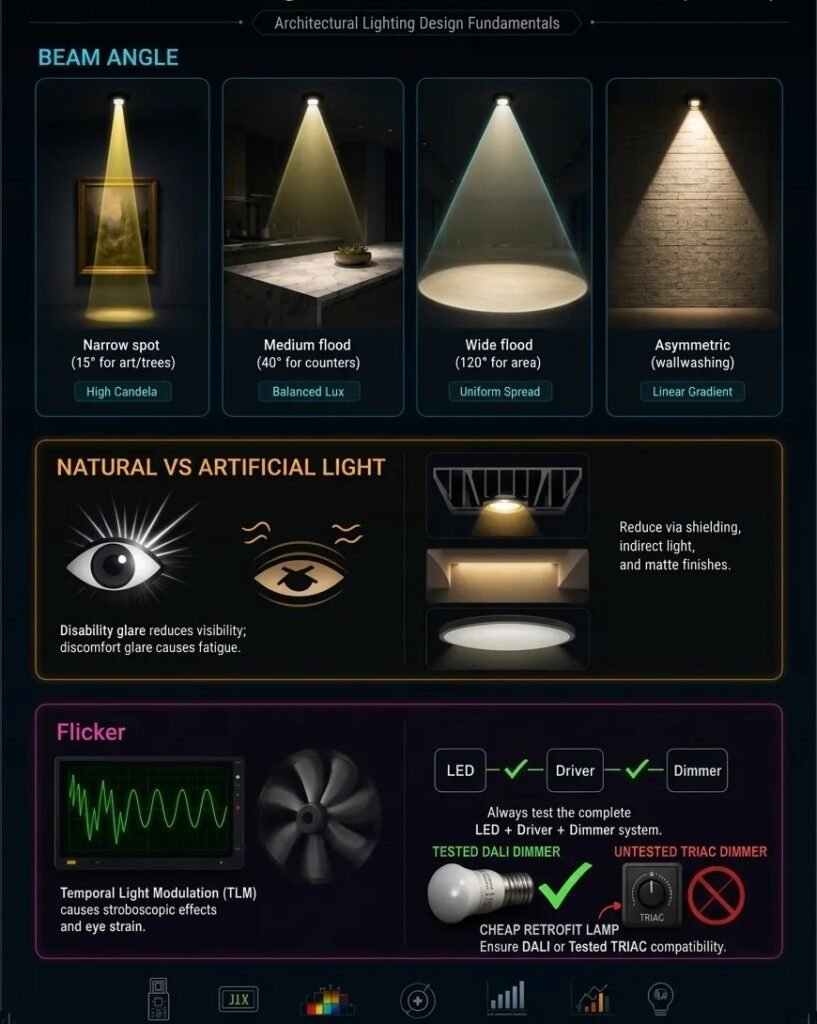
1.5 Beam Angle, Glare, and Flicker (TLM)
- Beam Angles: Narrow spot (15° for art/trees), Medium flood (40° for counters), Wide flood (120° for area), Asymmetric (wallwashing).
- Glare: Disability glare reduces visibility; discomfort glare causes fatigue. Reduce via shielding, indirect light, and matte finishes.
- Flicker (TLM): Temporal Light Modulation causes stroboscopic effects and eye strain. Always test the complete LED + Driver + Dimmer system. Avoid cheap retrofit lamps on incompatible dimmers.
1.6 IP, IK, and Hazardous Ratings
- IP Code (IEC 60529): First digit = solids, second digit = liquids. IP65 (water-jet), IP67 (temporary submersion), IP68 (continuous submersion).
- IK Code: Impact resistance.
- Note: IP rating does not prove suitability for corrosive salt-air, high-pressure washdown, or explosive atmospheres. For Karachi coastal projects, specify marine-grade 304 stainless steel or specialized powder-coating.
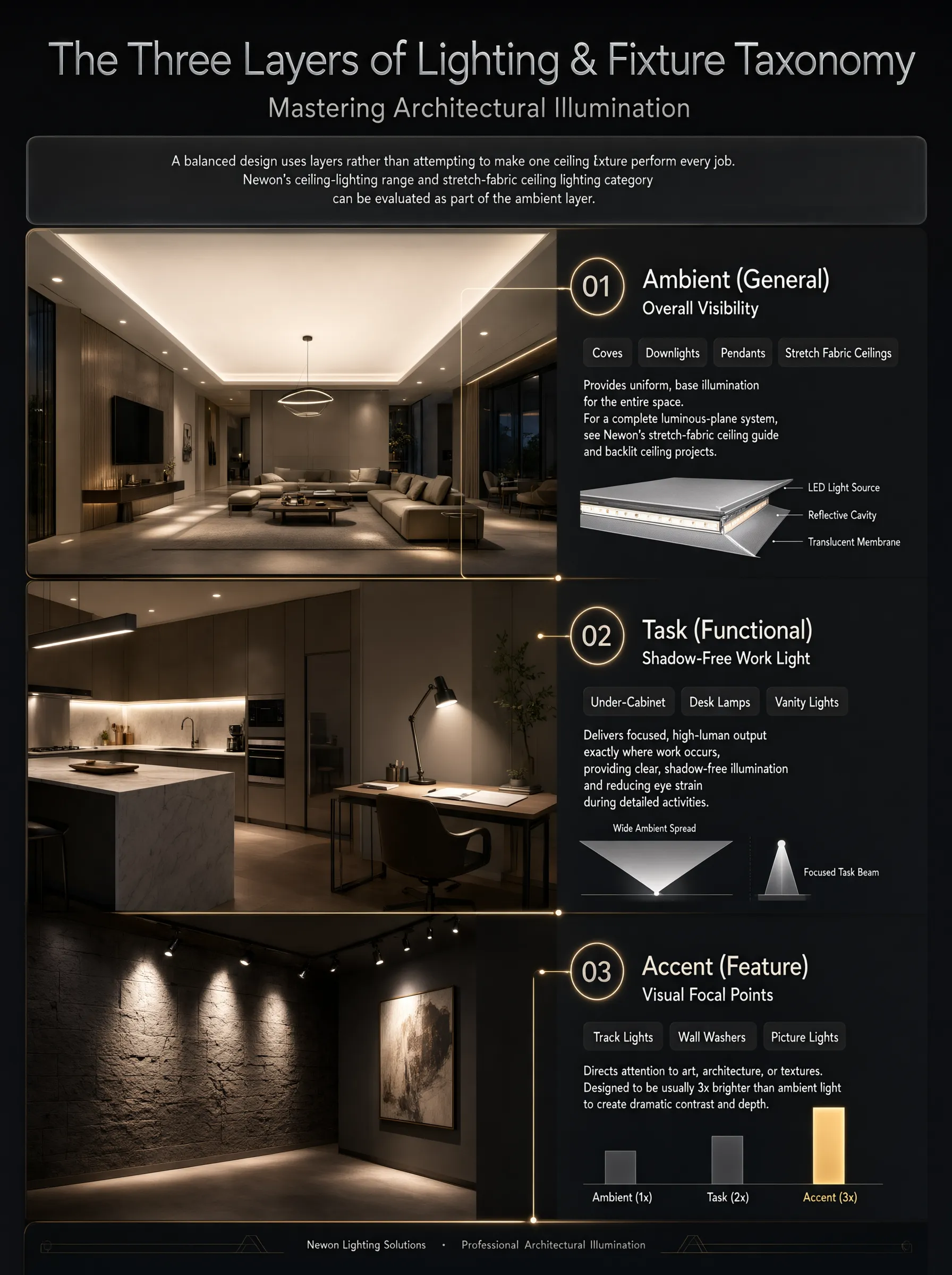
2. The Three Layers of Lighting & Fixture Taxonomy
A balanced design uses layers rather than attempting to make one ceiling fixture perform every job. Newon’s ceiling-lighting range and stretch-fabric ceiling lighting category can be evaluated as part of the ambient layer.
- Ambient (General): Overall visibility (coves, downlights, pendants, Stretch Fabric Ceilings). For a complete luminous-plane system, see Newon’s stretch-fabric ceiling guide and backlit ceiling projects.
- Task (Functional): Shadow-free light where work occurs (under-cabinet, desk, vanity).
- Accent (Feature): Directs attention to art, architecture, or textures (usually 3x brighter than ambient).
Light Source & Luminaire Families
- LED: Directional, efficient, long life (L70 lumen depreciation metric).
- Integrated vs. Replaceable: Integrated luminaires offer optical optimization but require full replacement if the driver fails. Replaceable lamps offer easy upgrades.
- Linear & Profiles: Continuous architectural lighting. See our 4-Inch Recessed Aluminium Profile for seamless ambient lines.
- High-Bay/Low-Bay: Warehouses and industrial spaces.
- Bollards & Path Lights: Low-level wayfinding.
3. Room-by-Room Residential Guide
Entry, Porch, and Foyer
Use a welcoming ambient layer plus focused light for faces and locks. Avoid single unshielded bright lamps that create deep shadows.
Living Room & Bedroom
Combine warm ambient light with floor/table task lamps and wallwashers. Use dimming and scenes. In bedrooms, keep controls reachable and avoid high-CCT ceiling lights as the only mode. For immersive ambiance, explore our Fibre Optic Star Ceiling Light Kits.
Kitchen & Dining
Provide general ceiling light and shadow-free task lighting at counters. Under-cabinet lights should be positioned toward the front working edge. Use our 5mm LED Strip 2835 for ultra-slim cabinet grooves. Over dining tables, use a pendant to create a focal pool, shielded from normal eye positions.
Bathroom & Vanity
Use balanced vertical light near both sides of the face. A single ceiling downlight creates unflattering shadows. Follow local wet-location separation distances.
Home Office & Stairs
Position screens to reduce reflected glare. For stairs, prioritize uniformity, handrail visibility, and step-edge contrast. Automate stair safety with our PIR Motion Sensor 32-Channel Staircase Controller for sequential step illumination.
4. Commercial, Industrial, and Public Spaces
For commercial projects, Newon provides commercial office lighting solutions and project-based design support.
Offices & Retail
Design for screen work, faces, and collaboration. Control high-angle glare. In retail, use vertical light for shelves and high-CRI accent light for merchandise hierarchy.
Restaurants & Hospitality
Lighting must support arrival, relaxation, and housekeeping. Use warm, dimmable layers. Our Luxury Rechargeable Metal Lamps provide cordless, touch-controlled tableside ambiance that survives loadshedding.
Warehouses & Workshops
Select high-bay luminaires for rack geometry and forklift movement. Avoid stroboscopic effects near rotating machinery. For automotive detailing and precision workshops, use modular studio lighting like our LED Hexagonal Car Garage Light (Hexagrid).
Museums & Galleries
Protect sensitive objects from excessive illuminance and UV. Use precise optics and specify conservation limits with the curator.
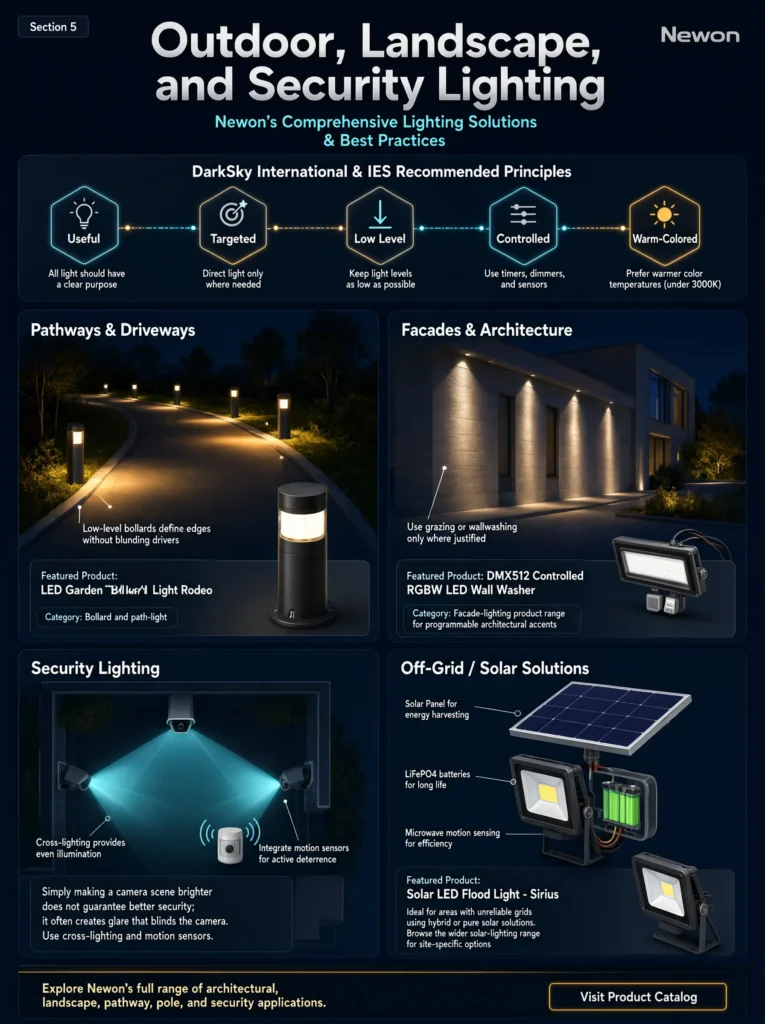
5. Outdoor, Landscape, and Security Lighting
Newon’s outdoor lighting range includes architectural, landscape, pathway, pole, and security applications.
DarkSky International and IES recommend five principles: light should be useful, targeted, low level, controlled, and warm-colored.
- Pathways & Driveways: Use low-level bollards to define edges without blinding drivers. See our LED Garden Bollard Light Rodeo and bollard and path-light category.
- Facades & Architecture: Use grazing or wallwashing only where justified. Use our DMX512 Controlled RGBW LED Wall Washer or review the facade-lighting product range for programmable architectural accents.
- Security: Simply making a camera scene brighter does not guarantee better security; it often creates glare that blinds the camera. Use cross-lighting and motion sensors.
- Off-Grid/Solar: For areas with unreliable grids, use hybrid or pure solar solutions like our Solar LED Flood Light – Sirius with LiFePO4 batteries and microwave motion sensing. Browse the wider solar-lighting range for site-specific options.
6. Specialty Lighting Applications
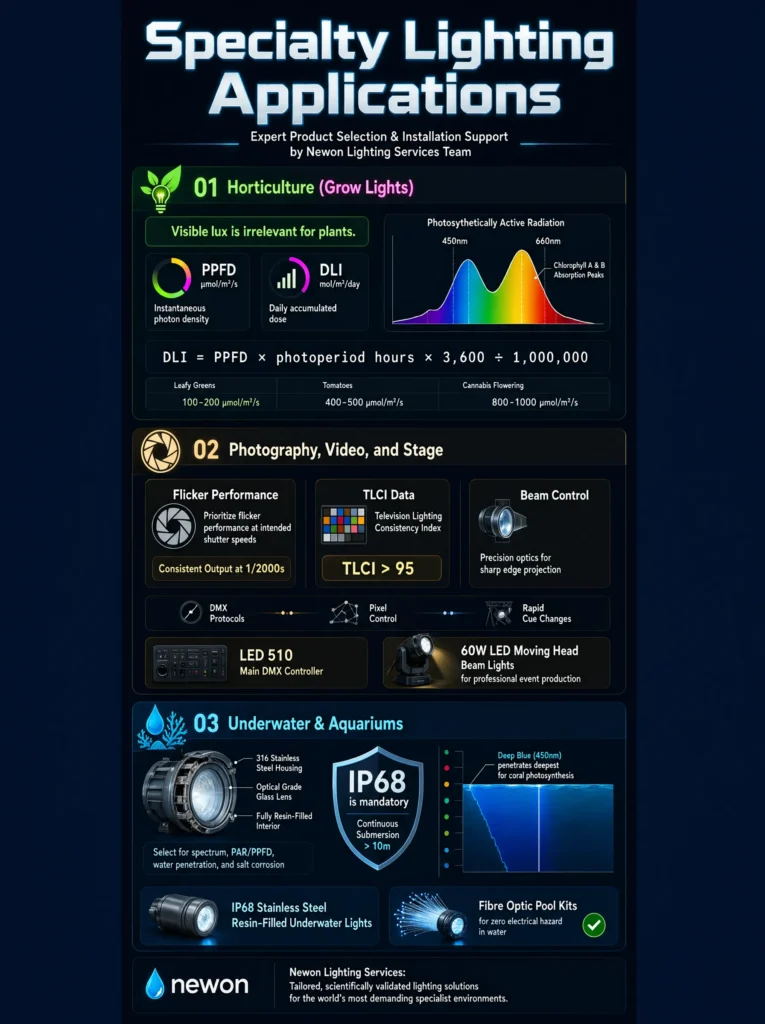
For specialist environments, Newon can support product selection and installation through its lighting services team.
Horticulture (Grow Lights)
Visible lux is irrelevant for plants. Use PPFD (micromoles/m²/s) for instantaneous photon density, and DLI (mol/m²/day) for daily accumulated dose.
Formula:
DLI = PPFD × photoperiod hours × 3,600 ÷ 1,000,000
Photography, Video, and Stage
Prioritize flicker performance at intended shutter speeds, TLCI data, and beam control. Stage systems require DMX protocols, pixel control, and rapid cue changes. Explore our LED 510 Main DMX Controller and 60W LED Moving Head Beam Lights for professional event production.
Underwater & Aquariums
Select for spectrum, PAR/PPFD, water penetration, and salt corrosion. IP68 is mandatory. Use our IP68 Stainless Steel Resin-Filled Underwater Lights or Fibre Optic Pool Kits for zero electrical hazard in water.
7. The Master Calculation Engine
These calculations are starting points. For a full project, request a professional lighting assessment from Newon so fixture photometry, mounting geometry, controls, and maintenance factors are checked together.
7.1 Basic Lumen Estimate
Required Lumens = (Area × Target Lux) ÷ (Utilization Factor × Maintenance Factor)
Example: A 20 m² room targeting 200 lux requires 4,000 lumens before losses. If UF × MF = 0.70, you need 5,714 installed lumens.
7.2 LED Strip Power Supply & Voltage Drop
For strip-light projects, compare the LED strip-light category with the correct high-efficiency smart power supply.
Power Required = Strip Watts/m × Installed Metres
Rule: Always add a 20% safety margin. For 24V strips longer than 5-7 metres, use parallel power injection at both ends to prevent voltage drop (dimming at the end of the run).
7.3 Electrical Energy & Operating Cost
Annual Cost = (Power in kW × Operating Hours) × Electricity Tariff
Local Context: Under Pakistan’s commercial tariffs (approx. PKR 43.83/kWh), upgrading from 400W HID to 150W LED high-bays saves millions annually in large warehouses.
8. Controls, Smart Systems, and Human-Centric Lighting
- Basic & Sensors: Use occupancy sensors for storage areas, vacancy sensors for offices.
- Daylight Harvesting: Separate perimeter and core zones.
- Tunable White (Circadian): Shifts from cool morning light to warm evening light. Use our Double CCT 2in1 Warm + Cool White LED Strip with RF controllers. For larger luminous surfaces, see the 2CCT oval stretch-fabric ceiling project at Sapphire.
- Protocols: DALI (addressable commercial), 0-10V (analog), DMX/SPI (dynamic architectural/entertainment). For smart home integration, use our Tuya App BT Control RGBW Bulbs.
9. Health, Safety, Accessibility, and Blue Light
- Blue Light Hazard: CIE states this refers specifically to photochemical retinal risk, not circadian disruption. Ordinary white LEDs at similar CCTs have similar exposure limits. Do not stare at bright sources.
- Accessibility: Provide even illumination on routes, clear contrast at edges, and low glare for reduced visual acuity.
- Emergency Lighting: Code matters, not decoration. Never disable emergency functions when integrating smart controls. Ensure central power failure is considered.
10. The Troubleshooting Matrix & Do’s/Don’ts
Newon’s stretch-fabric ceiling projects show how spacing, diffusion, geometry, and controls are resolved in completed installations.
| Problem | Likely Causes | First Checks |
|---|---|---|
| Room feels dim despite high lumens | Poor distribution, dark surfaces, glare | Measure lux at task; inspect beam and surface reflectance |
| Bright spots and dark patches | Incorrect spacing, narrow beam, poor diffusion | Review photometric layout and spacing-to-height ratio |
| Eye fatigue / Headaches | Glare, reflections, flicker (TLM) | Re-aim, shield, test TLM, reposition screens |
| LED flickers when dimmed | Incompatible dimmer, driver, or min-load issue | Test approved driver/dimmer combinations |
| Strip is bright at one end, dim at other | Voltage drop, undersized conductors | Verify voltage at both ends; use parallel injection |
| Colors look wrong / dull | Low CRI, spectrum mismatch, mixed CCT | Compare CRI/TM-30/R9; standardize sources |
| Fixture fails outdoors | Incorrect IP, condensation, corrosion | Verify enclosure, seals, drainage, and environment rating |
| Security lighting creates glare | Over-lighting, poor aiming, unshielded | Apply DarkSky principles (useful, targeted, low-level) |
| LED life is shorter than promised | Heat, enclosed fixture, driver failure | Check thermal path, ambient rating, and driver warranty |
The Golden Rules
DO: Start with the task. Use layers. Compare lumens, efficacy, and CRI. Match IP/IK to the exact environment. Publish test conditions.
DON’T: Choose by watts alone. Put bare high-output LEDs in the eye line. Treat IP65 as proof of submersion. Claim “flicker-free” without test data. Mix dimmers and drivers without compatibility checks.
11. FAQ & Glossary
What are the three types of lighting?
For practical examples, compare Newon’s indoor lighting products, outdoor lighting products, and lighting installation services.
Ambient (general visibility), Task (focused work light), and Accent (highlighting features). Every professional space requires all three.
Is 3000K or 4000K better for a kitchen?
3000K (warm) is preferred for residential kitchens to create a welcoming ambiance, while 4000K (neutral) is often used in commercial kitchens or over specific prep zones for visual clarity.
What IP rating is needed for outdoor lighting?
IP65 is standard for rain and dust. IP67 is required for ground-recessed lights that may pool water. IP68 is mandatory for underwater pool and fountain lights.
How do I stop LED lights from flickering?
Ensure your dimmer switch is specifically rated for LED loads, check that the total wattage meets the dimmer’s minimum load requirement, and verify that the LED driver supports the dimming protocol (e.g., TRIAC, 0-10V).
What is the difference between a floodlight and a spotlight?
Spotlights have narrow beam angles (15°-30°) for targeted accent lighting. Floodlights have wide beam angles (60°-120°) for broad area illumination.
Explore Newon’s Lighting Products, Services, and Completed Projects
Use this guide as the starting point for a project brief, then explore Newon’s complete lighting shop, lighting installation services, and completed project portfolio. For stretch-fabric ceiling work, review the plain white Barrisol ceiling range, backlit ceiling accessories, fire-retardant membrane information, and completed spa salon project, retail project at Shaheen Cosmetics, cloudy-sky ceiling project, and medical-clinic ceiling project. To discuss a project, contact Newon.
Sources and Citations
- CIE S 008 / ISO 8995-1: Lighting of Work Places (Indoor).
- NIST: Candela and Photometry definitions.
- ENERGY STAR: LED Basics and Lumen Depreciation (L70).
- U.S. DOE: TM-30 Frequently Asked Questions & Flicker/TLM Review.
- IEC 60529: Ingress Protection (IP) Ratings.
- OSHA 29 CFR 1926.56: Construction Illumination Standards.
- IES: Recommended Practice for Hospitality Spaces.
- DarkSky International: Five Principles for Responsible Outdoor Lighting.
- Iowa State / Virginia Tech Extension: PPFD and DLI Calculations for Horticulture.
- CIE Position Statement: Blue Light Hazard.