


- INDOOR LIGHTS
- 360 Degree Neon Customised Lighting
- Magnetic Track Lights
- Skyline Steel Strip Lighting
- Chandelier & Pendant
- Down Lights
- Bulbs
- Surface Mounted Lights
- Led Rope Light
- Led panels
- Cabinet & Wardrobe Lights
- Led Tube and Batten Lights
- Linear Hanging & Recessed Bar Lights
- Track Lights
- Wall Lights
- Fibre Optic Ceiling Lights
- Lamps
- OUTDOOR LIGHTS
- SOLAR LIGHTS
- Disco and Party Lighs
- Led Addressable Lights & Controllers
- Fibre Optic Lights
- Stretch Fabric Ceiling Light
- Silicone Profile Light
- Led Strip Lights
- Led Aluminium Profile
- Led Adapters & Power Supplies
- Customized Lights
- Led tree Lighting and Decoration
- OTHER PRODUCTS

LiFePO4 vs Li-ion: The Complete Pakistan Battery Cell Guide for Solar, E-Bikes & Power Tools

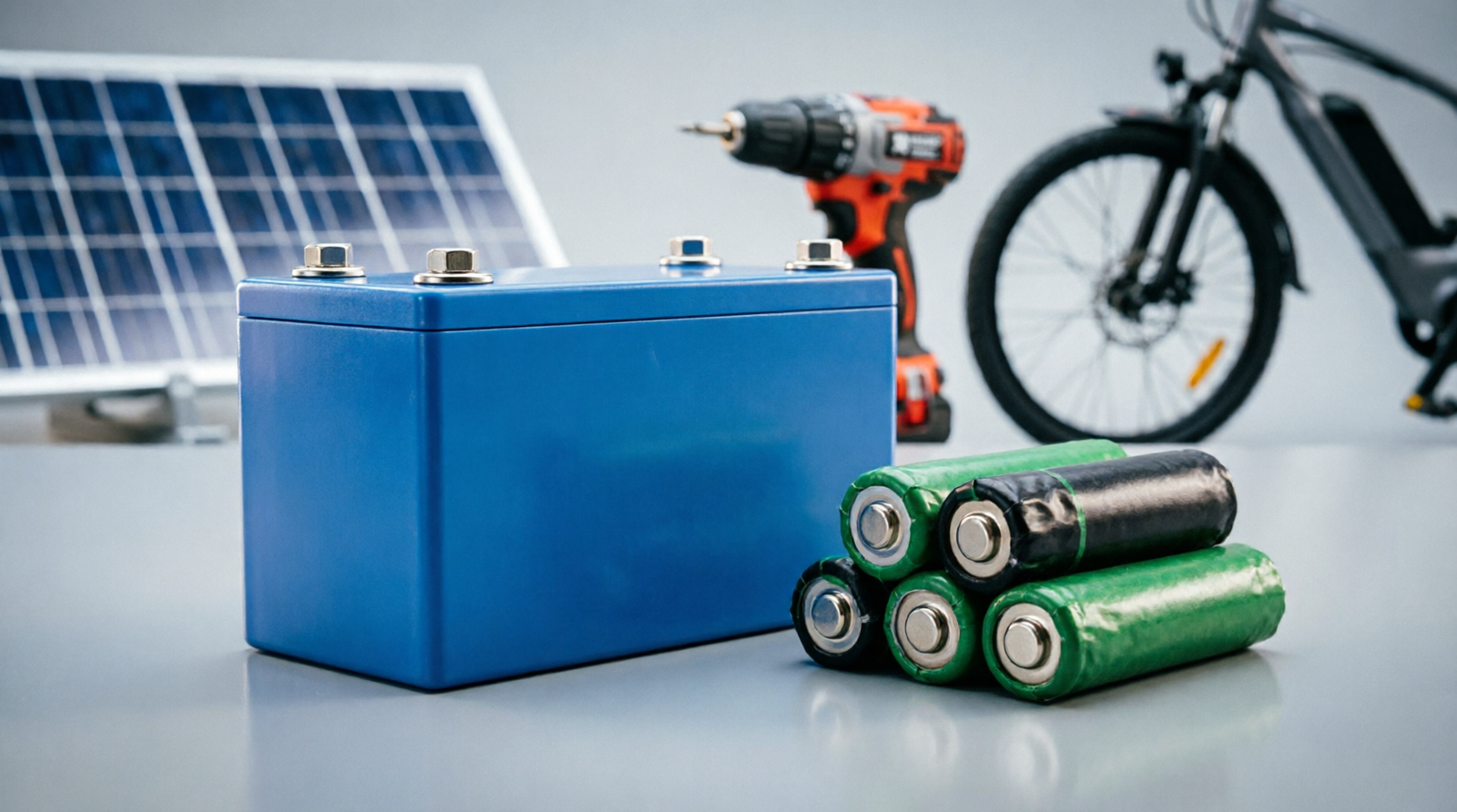
If you’re building a solar backup bank in Karachi, rebuilding a cordless drill battery in Lahore, or assembling an e-bike pack in Islamabad, you face the same question:
Should I use LiFePO4 cells or Li-ion cells?
Pick the wrong chemistry and you either waste money on overkill or create a fire hazard. This guide breaks down the real differences — at the cell level — so you buy exactly what your build needs. No fluff. No generic advice. Just the specs, costs, and safety facts that matter in Pakistan’s climate.
📦 What Newon Stocks: We supply both chemistries — EVE 18650 Li-ion high-drain cells, 18650 3500mAh endurance cells, LiFePO4 21700 cells, LiFePO4 prismatic cells, and JK Smart BMS units. WhatsApp us for project advice.
The 30-Second Answer
| Your Build | Choose This | Why |
|---|---|---|
| Solar / LED backup bank | LiFePO4 (prismatic or 21700) | 6000+ cycles, 95% DoD, safe, 10–15 year life |
| E-bike / power tool pack | 18650 Li-ion (high-drain) | 30A+ discharge, compact, energy-dense |
| Flashlight / USB power bank | 18650 Li-ion (3500mAh 3C) | High capacity, moderate drain, low cost |
| Large off-grid home storage | LiFePO4 prismatic | Scalable, cool-running, Pakistan heat-proof |
What Are LiFePO4 and Li-ion Cells?
Both are lithium-based. Both recharge. Both beat lead-acid. But their internal chemistry is completely different.
LiFePO4 (Lithium Iron Phosphate / LFP)
- Voltage: 3.2V nominal per cell
- Cathode material: Lithium iron phosphate — stable, cobalt-free
- Best known for: Safety, long life, thermal stability
- Common formats: Cylindrical (21700), prismatic (brick-shaped), pouch
18650 Li-ion (NMC / INR — Nickel Manganese Cobalt)
- Voltage: 3.6–3.7V nominal per cell
- Cathode material: Nickel, manganese, cobalt mix
- Best known for: High energy density, compact size, high discharge rates
- Common formats: 18650 (18mm × 65mm), 21700, 26650
Side-by-Side: LiFePO4 Cell vs 18650 Li-ion Cell
| Spec | LiFePO4 Cell | 18650 Li-ion Cell (NMC) |
|---|---|---|
| Nominal voltage | 3.2V | 3.6–3.7V |
| Energy density | 90–160 Wh/kg | 150–250 Wh/kg |
| Cycle life | 4000–6000+ cycles | 500–2500 cycles (varies by C-rate) |
| Depth of discharge | 80–95% usable | 70–80% usable (for longevity) |
| Continuous discharge | 1C–3C typical (up to 10C on some) | 3C–30C available |
| Thermal safety | Excellent — no thermal runaway | Good — needs BMS + thermal management |
| Heat tolerance | Up to 60°C operation | Up to 45–50°C |
| Weight per kWh | Heavier (~10 kg/kWh) | Lighter (~5–6 kg/kWh) |
| Cost per cell (Newon) | PKR varies by format — prismatic 27Ah / 21700 6Ah | PKR 1,000 (3500mAh 3C) / PKR 1,050 (3000mAh 10C) |
| Best for Pakistan | Solar storage, home backup | Power tools, e-bikes, flashlights |
Which Chemistry for Which Application? (Pakistan Builds)
1. Solar & Home Backup Banks → LiFePO4 Wins
Pakistan averages 9.5 hours of sunlight daily but suffers chronic loadshedding. A solar battery bank cycles every single day. That is exactly where LiFePO4 dominates.
Why LiFePO4 for solar:
- 6000+ cycles = 16+ years of daily use
- 95% depth of discharge — you use almost the full capacity every night
- No maintenance — no water topping like tubular lead-acid
- Heat-proof — handles 50°C+ Lahore summers without degrading
- Safe inside the home — no thermal runaway risk
Real math for a Pakistani home:
| Setup | LiFePO4 Cost | Tubular Lead-Acid Cost | 10-Year Winner |
|---|---|---|---|
| 10 kWh usable backup | ~Rs 9.6 lakh installed | ~Rs 6.7 lakh + 2 replacements + maintenance | LiFePO4 saves ~Rs 8 lakh |
Newon’s LiFePO4 options for solar:
- LiFePO4 Prismatic 3.2V 27Ah — Large-format cells for 12V/24V/48V home banks
- LiFePO4 21700 3.2V 6Ah — Compact cylindrical for smaller portable solar builds
- JK Smart BMS (8–24S, Bluetooth) — Mandatory for any multi-cell LiFePO4 pack
2. Power Tool Battery Rebuilds → 18650 Li-ion Wins
Professional cordless drills, saws, and grinders pull 15–30A continuous during cutting and drilling. LiFePO4 cells simply cannot deliver that current in a compact 18650 format without becoming huge and heavy.
Why 18650 Li-ion for power tools:
- 10C / 30A continuous available in standard 18650 size
- Energy-dense — more Wh per gram than LiFePO4
- Direct OEM replacement — most tool packs were originally built with 18650 NMC cells
- Spot-weld compatible — flat-top 18650s fit standard battery holders
Newon’s pick: EVE INR18650/30P — 3000mAh, 10C (30A) continuous discharge. Genuine EVE Energy cell, ≤18 mΩ internal resistance, PKR 1,050/cell.
3. E-Bike & E-Scooter Packs → 18650 Li-ion Wins
E-bike motors demand high current during acceleration and hill climbing. A 10S4P pack (10 series, 4 parallel) built with 10C cells can deliver 120A continuously — enough for any Pakistani e-bike or scooter.
Why 18650 Li-ion for e-bikes:
- High C-rate handles acceleration surges without voltage sag
- Compact pack size fits inside frame tubes or under-seat boxes
- Lighter weight = better range and handling
Configuration tip: 10S = 36V nominal. 13S = 48V nominal. Always use a matched BMS with over-current protection set 20% above your motor controller’s max draw.
4. High-End Flashlights & USB Power Banks → 18650 Li-ion Wins
These are low-to-moderate drain devices. You want maximum runtime, not maximum amps. A 3500mAh 3C cell delivers 10.5A — more than enough for any flashlight turbo mode or 2A USB output.
Newon’s pick: 18650 3500mAh 3C Cell — PKR 1,000/cell. 17% more runtime than 3000mAh cells. Free shipping on 10+.
Cost Per kWh: The Real Pakistan Math
Most Pakistani buyers look at price per cell. Smart buyers look at cost per kWh over the battery’s life.
| Metric | LiFePO4 Prismatic (27Ah) | 18650 Li-ion (3500mAh 3C) | 18650 Li-ion (3000mAh 10C) |
|---|---|---|---|
| Cell voltage | 3.2V | 3.6V | 3.6V |
| Cell capacity | 27,000 mAh | 3,500 mAh | 3,000 mAh |
| Energy per cell | 86.4 Wh | 12.6 Wh | 10.8 Wh |
| Cells needed for 1 kWh | ~12 cells | ~80 cells | ~93 cells |
| Cycle life | 4000–6000 | ~1000–1500 | ~250–500 (at 10C) |
| Best use case | Solar / home storage | Flashlights / power banks | Power tools / e-bikes |
Bottom line: For solar, LiFePO4 costs more upfront but is 5× cheaper per cycle. For power tools and e-bikes, 18650 Li-ion is the only practical choice regardless of cost.
Cell Formats Explained: What Newon Actually Stocks
Not all cells look the same. The format determines how you build your pack.
18650 Cylindrical (Li-ion)
- Size: 18mm diameter × 65mm length
- Voltage: 3.6–3.7V nominal
- Best for: Spot-welded packs, battery holders, tool rebuilds
- Newon stock: 3500mAh 3C | EVE 3000mAh 10C
21700 Cylindrical (LiFePO4)
- Size: 21mm diameter × 70mm length
- Voltage: 3.2V nominal
- Best for: Compact LiFePO4 packs where prismatic won’t fit
- Newon stock: LiFePO4 21700 3.2V 6Ah
Prismatic (LiFePO4)
- Size: Flat rectangular “brick” cells
- Voltage: 3.2V nominal
- Best for: Large solar banks, EV builds, stationary storage
- Newon stock: LiFePO4 Prismatic 3.2V 27Ah
The BMS Factor: Why Both Chemistries Need Protection
Every multi-cell pack — LiFePO4 or Li-ion — needs a Battery Management System (BMS). Period.
A BMS does four critical things:
- Cell balancing — keeps all cells at the same voltage
- Overcharge protection — stops charging at 4.2V (Li-ion) or 3.65V (LiFePO4)
- Over-discharge protection — cuts load at 2.5V (Li-ion) or 2.0V (LiFePO4)
- Over-current protection — prevents short-circuit fires
Without a BMS: Your pack will die within months. Cells drift out of balance. One cell overcharges. Another over-discharges. The pack swells, overheats, or catches fire.
Newon’s BMS solution: JK Smart BMS (8–24S, Bluetooth, 40A/60A/100A) — works with both LiFePO4 and Li-ion, monitors cell voltage via app, and handles Pakistani temperature ranges.
5 Mistakes Pakistani Builders Make (And How to Avoid Them)
❌ Mistake 1: Buying “6800mAh” 18650 Cells
Reality: No genuine 18650 exceeds ~3500mAh. Anything higher is a fake wrapper on a recycled laptop cell.
Fix: Buy from verified suppliers. Genuine 3500mAh cells weigh ~48–50g. Fakes weigh under 40g.
❌ Mistake 2: Using LiFePO4 for Power Tools
Reality: LiFePO4 cells are safe and long-lasting, but a 1 kWh LiFePO4 pack is 2× heavier and 3× bulkier than a 1 kWh 18650 pack. Your drill becomes unwieldy.
Fix: Use high-drain 18650 cells for portable high-current builds. Use LiFePO4 for stationary solar.
❌ Mistake 3: Skipping the BMS to Save Money
Reality: A “cheap” pack without a BMS dies in 3–6 months. You then spend 10× the BMS cost replacing cells.
Fix: Budget for a quality BMS from day one. It is non-negotiable.
❌ Mistake 4: Mixing Old and New Cells
Reality: In a series string, all cells must match in capacity and internal resistance. Adding one new cell to three old cells kills the new cell in weeks.
Fix: Buy matched cells in one batch. Newon supplies capacity-matched cells for pack builders.
❌ Mistake 5: Building Without a Load Calculation
Reality: Most Pakistani builders guess their battery size. They end up with either a bank that dies in 30 minutes or one that costs twice what they needed.
Fix: Contact Newon for custom battery sizing. We calculate your exact voltage, capacity, and C-rate requirements.
Frequently Asked Questions
Can I charge LiFePO4 and Li-ion with the same charger?
No. LiFePO4 charges to 3.65V per cell. Li-ion charges to 4.2V per cell. Using a Li-ion charger on LiFePO4 undercharges it. Using a LiFePO4 charger on Li-ion overcharges it — fire risk. Always match your charger to your chemistry.
Which battery is better for loadshedding in Pakistan?
For daily cycling (solar charging during day, discharging every evening), LiFePO4 is better. It handles 6000+ cycles, works in 50°C heat, and needs zero maintenance. For occasional UPS backup, a smaller Li-ion pack may be cheaper upfront but won’t last as long.
Is LiFePO4 really safer than 18650 Li-ion?
LiFePO4 is more thermally stable — it will not enter thermal runaway if punctured or overcharged. both are safe when used with a quality BMS, proper enclosure, and correct charging. No battery is “100% safe” if abused.
How many 18650 cells do I need for a 1 kWh e-bike pack?
At 3.6V and 3000mAh per cell, each cell holds 10.8 Wh. For 1 kWh: ~93 cells. A typical 36V 10Ah e-bike pack (360 Wh) uses 40 cells in 10S4P configuration. A 48V 15Ah pack (720 Wh) uses 65 cells in 13S5P.
What is the price of LiFePO4 cells in Pakistan?
Large-format LiFePO4 prismatic cells range from Rs 80,000–105,000 per kWh depending on brand and BMS quality. Newon stocks individual prismatic cells for DIY builders at project-friendly rates. WhatsApp for bulk pricing.
Can Newon build a custom battery pack for me?
Yes. Newon offers custom battery solutions for solar installers, e-bike shops, and industrial clients. We handle cell matching, spot-welding, BMS integration, and testing. See all our services.
Final Verdict: Which Cell Should You Buy?
Buy LiFePO4 if: You’re building solar storage, home backup, or any system that cycles daily and stays stationary. The 10-year cost savings and safety are unbeatable.
Buy 18650 Li-ion if: You’re rebuilding power tools, building e-bike packs, or need compact portable power. The energy density and high C-rates are essential.
Still unsure? WhatsApp Newon on +92 343 9227883 with your voltage and current requirements. We’ll recommend the exact cell, configuration, and BMS for your build.
Explore Newon’s Battery & Energy Range
- All Solar & Energy Storage Products
- EVE 18650 3000mAh 10C (30A) High-Drain Cell — PKR 1,050
- 18650 3500mAh 3C Endurance Cell — PKR 1,000
- LiFePO4 21700 Cylindrical 3.2V 6Ah
- LiFePO4 Prismatic 3.2V 27Ah
- JK Smart BMS (8–24S, Bluetooth)
- Custom Battery Pack Building Services
- Solar & LED Installation Services
📍 Newon Pakistan
Office No. 1, Plot #235, Street 6, Near Total Pump, I-9/2, Islamabad
📞 +92 343 9227883 | 💬 WhatsApp Order | 📧 info@newon.pk