

- INDOOR LIGHTS
- 360 Degree Neon Customised Lighting
- Magnetic Track Lights
- Skyline Steel Strip Lighting
- Chandelier & Pendant
- Down Lights
- Bulbs
- Surface Mounted Lights
- Led Rope Light
- Led panels
- Cabinet & Wardrobe Lights
- Led Tube and Batten Lights
- Linear Hanging & Recessed Bar Lights
- Track Lights
- Wall Lights
- Fibre Optic Ceiling Lights
- Lamps
- OUTDOOR LIGHTS
- SOLAR LIGHTS
- Disco and Party Lighs
- Led Addressable Lights & Controllers
- Fibre Optic Lights
- Stretch Fabric Ceiling Light
- Silicone Profile Light
- Led Strip Lights
- Led Aluminium Profile
- Led Adapters & Power Supplies
- Customized Lights
- Led tree Lighting and Decoration
- OTHER PRODUCTS

Building Facade and landscape lighting at HIT officers mess Taxila


A 50-year-old building carries decades of character, history, and architectural detail in its columns, arches, and masonry. By day that character is self-evident. After dark, without lighting, the building disappears entirely — its columns become shadows, its arches dissolve, its identity evaporates. The right facade lighting does not merely illuminate a building. It reveals it, restores its presence at night, and returns its architectural character to visibility in a way that respects the building’s age and dignity.
This project documents the comprehensive facade and landscape lighting design and installation completed by Newon for the Officers Mess building at Heavy Industries Taxila (HIT) — a landmark institutional structure approximately 50 years old at the time of the project, built in the era when HIT was established as Pakistan’s premier defence manufacturing complex under the Ministry of Defence Production. The project brief was to illuminate and visually enhance the building’s key architectural elements during the hours of darkness — transforming it from an invisible mass into a lit landmark within the HIT campus.
This case study is relevant for government and institutional building managers planning facade lighting upgrades, architects and heritage consultants specifying lighting for historic or period buildings, and contractors delivering architectural facade illumination for institutional clients across Pakistan.
Project Context: The Officers Mess at Heavy Industries Taxila
Heavy Industries Taxila is one of Pakistan’s most significant strategic defence institutions — a state-owned enterprise under the Ministry of Defence Production located in Taxila, Punjab, approximately 35km north-west of Rawalpindi. Inaugurated in 1979 by President Zia-ul-Haq as the Heavy Rebuild Factory, HIT specialises in manufacturing, rebuilding, and developing tanks and armoured vehicles. The complex spans over 1,400 acres and employs more than 6,500 engineers, technicians, and support staff across six major production units and extensive support facilities.
The Officers Mess at HIT is a historic institutional building constructed in the establishment’s early decades — approximately 50 years old at the time of this lighting project. Like many buildings of its era in Pakistan’s military and industrial complexes, it features a formal architectural character with distinctive structural elements: colonnaded frontage with vertical columns, arched openings between the columns, and a surrounding landscape with mature trees. These are the elements that define the building’s institutional dignity and architectural identity.
The management of the Officers Mess approached Newon with a brief that was as much about philosophy as specification: illuminate the building in a way that enhances its character without obscuring or overpowering it, and ensures it reads as a distinguished institutional landmark within the HIT campus after dark.
“It would have been impossible to illuminate every aspect of the building, and it wasn’t desirable to do so. This would mean some architectural detail would be hidden from view — but we could focus on the most impressive and significant details. The design emphasises the large features: columns and arches, focusing on the rhythm of the building’s composition while paying particular attention to the overall facade.”
— Abdullah Nisar, Newon
Design Philosophy: Selective Illumination, Not Comprehensive Flooding
The most common mistake in historic and institutional building facade lighting is attempting to illuminate everything. Flood-lighting an entire building surface uniformly flattens its three-dimensional form, washes out textures, erases the depth created by architectural relief, and — critically — produces a result that looks institutional and undifferentiated rather than considered and architectural.
For the HIT Officers Mess, Newon adopted a selective illumination philosophy — the internationally recognised approach for heritage and period buildings, aligned with best practices established by the International Commission on Illumination (CIE) for architectural facade lighting. The principle is simple: choose the elements that define the building’s identity and illuminate only those, allowing the spaces between to remain in shadow.
For the HIT Officers Mess, four architectural and landscape elements were identified as the primary illumination targets:
- The columns — the defining vertical rhythm of the colonnaded facade, establishing the building’s formal institutional character
- The arches — the connective architectural element between columns, forming the characteristic visual pattern of the frontage
- The facade walls — the broad masonry surfaces between and behind the columns, which carry the building’s material texture and depth
- The landscape trees — the mature trees within the surrounding grounds, which form the natural frame around the illuminated building
Everything else was left dark — not by oversight, but by design. The contrast between lit elements and dark spaces creates the visual depth that makes a well-lit building look three-dimensional and dramatic at night, rather than flat and uniformly bright.
Fixture 1 — Beam Lights: Uplighting the Columns
LED beam lights were selected for the column illumination — their narrow beam angle (10°–25°) precisely contains the light within the column width, ensuring each column receives crisp, focused upward illumination without spillage onto adjacent surfaces.
Why Uplighting for Columns
Columns are inherently vertical architectural elements whose character is defined by their height, proportion, and the texture of their material surface. Uplight — placing the beam source at the column base and projecting light upward — is the most effective technique for revealing all three of these qualities simultaneously:
- Height — the upward beam emphasises the column’s full vertical dimension, making it appear taller and more imposing than frontal illumination would
- Proportion — the gradual reduction in light intensity as it travels upward creates a visual gradient that reinforces the column’s proportional character
- Texture — the grazing angle of light from the base creates shadows in surface irregularities and material texture that frontal lighting would completely flatten
By placing a beam light at the base of each column across the full colonnaded facade, Newon recreates the building’s defining vertical rhythm at night — the colonnade, which is the building’s primary architectural statement, becomes its primary nighttime statement as well.
Newon supplies LED beam lights, beam spot lights, and mini spot lights for column, facade accent, and architectural illumination applications across Pakistan.
Fixture 2 — Neon Rope Light: Tracing the Arches
The arches connecting the columns are the building’s secondary architectural rhythm — a repeating curved form that contrasts with the vertical geometry of the columns and creates the characteristic visual pattern of the colonnaded facade. Illuminating the arch curves requires a fixture as flexible as the curve itself.
Why Neon Rope Light for Arch Illumination
LED neon rope light — also known as 360° LED neon flex — was selected because its flexibility allows it to follow the curved profile of the arches precisely, producing a continuous, smooth glow that traces the arch geometry without the hotspots and visual interruptions that individual LED strip lights would produce at close viewing distances.
Unlike standard LED strips (where individual LED points can be visible from close range), neon rope light’s diffusing silicone jacket produces a genuinely smooth, even output along its full length — identical in appearance to traditional glass neon tubes but using energy-efficient LED technology with far longer lifespan and far lower maintenance requirements.
Installed within the arch reveals, the neon rope light becomes a glowing outline of each arch at night — visible from any viewing angle across the campus, reinforcing the building’s architectural pattern in warm light that complements the column uplighting above it.
Newon’s neon rope light range includes the 360° round neon rope and the customised neon lighting range for architectural and signage applications.
Fixture 3 — Buried Floor Lights: Wall Grazing
LED buried floor lights were installed at the base of the building’s facade walls, angled upward to project grazing light across the masonry surface — a technique known as wall grazing.
Why Wall Grazing Reveals More Than Frontal Lighting
The physics of grazing light on textured surfaces produces a result that no frontal floodlight can match. When light strikes a textured wall at a very shallow angle — from a source positioned close to and almost parallel with the wall surface — every irregularity, joint line, and surface relief becomes a miniature light-and-shadow sculpture. The texture that appears flat and featureless under frontal light reveals its full three-dimensional character under grazing light.
For the HIT Officers Mess — a 50-year-old masonry building with the natural surface variation, weathering, and material richness that comes with age — this grazing uplight technique turns the building’s age into an aesthetic asset. The texture accumulated over decades of Pakistan’s climate cycles (monsoon weathering, dust, thermal expansion and contraction) becomes the medium through which the light creates its effect.
All buried floor light fixtures were specified IP67 rated per IEC 60529 international standards — essential for ground-level outdoor fixtures in Taxila’s full climate range, where monsoon season waterlogging is a standard annual occurrence.
Fixture 4 — Spike Lights: Landscape Tree Illumination
LED spike lights were installed within the landscape grounds surrounding the Officers Mess, positioned at the bases of the mature trees to project upward light through the foliage and canopy.
The Role of Landscape Lighting in Building Illumination
The trees surrounding an institutional building are not separate from the building’s nighttime visual identity — they are part of it. Mature trees, properly lit, frame and contextualise the illuminated building, giving it visual depth and setting that a building illuminated in isolation, against a completely dark landscape, does not possess.
Spike lights inserted into the ground near each tree project upward beams through the canopy from below — creating dramatic backlit crown silhouettes where the foliage appears as a complex, organic pattern of dark leaves against the lit sky of the canopy above. At night, each tree becomes a luminous form that frames and complements the building’s formal geometric illumination.
The contrast between the organic, irregular shapes of the spike-lit trees and the precise geometric lines of the column and arch illumination creates a visual composition that is richer and more complete than either element alone.
Complete Technical Specifications — All Four Zones
| Zone | Fixture Type | Lighting Technique | Architectural Element |
|---|---|---|---|
| Columns | LED beam lights | Uplighting — narrow beam from base | Vertical rhythm of colonnaded facade |
| Arches | LED neon rope light | Profile outlining — follows arch curve | Curved arch openings between columns |
| Facade walls | LED buried floor uplights | Wall grazing — upward from ground level | Masonry facade surface texture |
| Landscape trees | LED spike lights | Uplight — through canopy from ground | Mature trees in surrounding landscape |
| Colour temperature (all zones) | 3000K warm white | ||
| Client | Officers Mess Management, Heavy Industries Taxila (HIT) | ||
| Building age | Approximately 50 years (constructed c. 1970s) | ||
Final Result: A 50-Year-Old Building Restored to Nighttime Prominence
The completed facade and landscape lighting installation at the HIT Officers Mess delivered the transformation the management had commissioned: a building that was invisible at night became a distinguished illuminated landmark on the HIT campus.
The specific outcomes of the installation:
- Architectural hierarchy revealed — the building’s columns, arches, and facade walls read clearly as distinct, individually illuminated elements at night rather than merging into a uniform illuminated mass
- Building character preserved — the selective illumination approach and 3000K warm colour temperature honour the building’s age and institutional dignity rather than imposing a contemporary aesthetic
- Depth and drama achieved — the contrast between lit elements and shadowed areas creates a three-dimensional, visually compelling nocturnal appearance that flat floodlighting could never produce
- Landscape integration — the spike-lit trees frame the building in organic light that contextualises and completes the composition rather than leaving the building isolated against a dark background
- Daytime discretion — all fixtures positioned at ground level or within architectural reveals, minimally visible during daylight hours without altering the building’s daytime appearance
As Newon documented at the project’s conclusion: the work helped deliver an incredibly powerful project that made a significant contribution to the impression of the building. For a 50-year-old institutional building at one of Pakistan’s most important defence facilities, this was precisely the brief — and precisely the result.
Planning Facade Lighting for Government and Institutional Buildings in Pakistan
The HIT Officers Mess project offers a design template applicable to any government institution, military facility, educational establishment, or historic building in Pakistan that requires exterior lighting sensitive to the building’s character:
Start with Selective Analysis, Not Comprehensive Coverage
The first decision in any institutional facade lighting brief is which elements to illuminate and which to leave dark. This decision shapes every subsequent specification choice. Buildings with colonnaded facades prioritise column uplighting; buildings with ornamental facades prioritise detail accent lighting; buildings with strong horizontal lines prioritise wall washing. The building’s own architecture determines the lighting strategy — not a predetermined product list.
Use 3000K for All Historic and Heritage Buildings
Warm white (3000K) is non-negotiable for historic and period buildings. It complements aged stone, brick, and plaster finishes, creates a dignified and respectful atmosphere, and is recommended by the CIE (International Commission on Illumination) and IES for heritage architectural illumination.
Specify IP67 for All Ground-Level Fixtures
All buried floor lights and ground-level spike fixtures must be rated IP67 per IEC 60529 for outdoor use in Pakistan’s monsoon climate. IP65-rated fixtures are not appropriate for ground installation in areas subject to waterlogging. Non-compliant fixtures fail within one to two monsoon seasons, creating both maintenance costs and safety hazards.
Plan for Daytime Discretion
Historic and institutional buildings should not have their daytime character altered by surface-mounted lighting hardware. All fixtures should be positioned at ground level, within architectural recesses, or in locations where they are not visible from the primary viewing angles of the building during daylight hours.
For Architects, Heritage Consultants & Contractors: Historic Building Facade Lighting
Newon supplies complete architectural facade lighting systems for government buildings, institutional campuses, heritage structures, and historic buildings across Pakistan. For professional clients:
- Full beam light range — LED beam lights, beam spot lights, mini spot lights, and outdoor COB spotlights
- Neon rope and profile lighting — 360° round neon rope and customised neon lighting for arch, portal, and ornamental illumination
- In-ground and buried lights — in-ground recessed lights and buried garden walkway lights (IP67 rated) for wall grazing and path illumination
- Spike lights — full spike light range for tree, planting, and landscape uplighting
- Full facade lighting range — LED facade lights, flexible wall washers, and DMX-controlled RGBW wall washers for contemporary facade applications
- Institutional and government project experience — HIT Officers Mess Taxila, DHA Phase 2 mosque facades, World Bank Building Islamabad, Rashakai SEZ, Peshawar Museum (KP Government KITE project), Srinagar Highway OIC Conference illumination
For architectural and heritage building lighting projects in the UAE and GCC — including landmark mosques, palaces, and historic buildings across the region — newon.ae provides equivalent supply and consultation services.
To discuss a government, institutional, or heritage building lighting project:
📧 info@newon.pk | 📞 +92 343 9227883 | 💬 WhatsApp
More Facade and Architectural Lighting Projects by Newon
- Mosque Facade Lighting — DHA Phase 2, Islamabad
- Commercial Facade Lighting — Union Square, D-12 Islamabad
- Contemporary House Facade Lighting — City Housing, Sialkot
- Heritage Building Illumination — Peshawar Museum, KP Government KITE Project
- Heritage Building Illumination — Sethi House, Peshawar (KITE Project)
- LED Facade & Street Lighting — Rashakai Special Economic Zone
- View All Newon Projects →
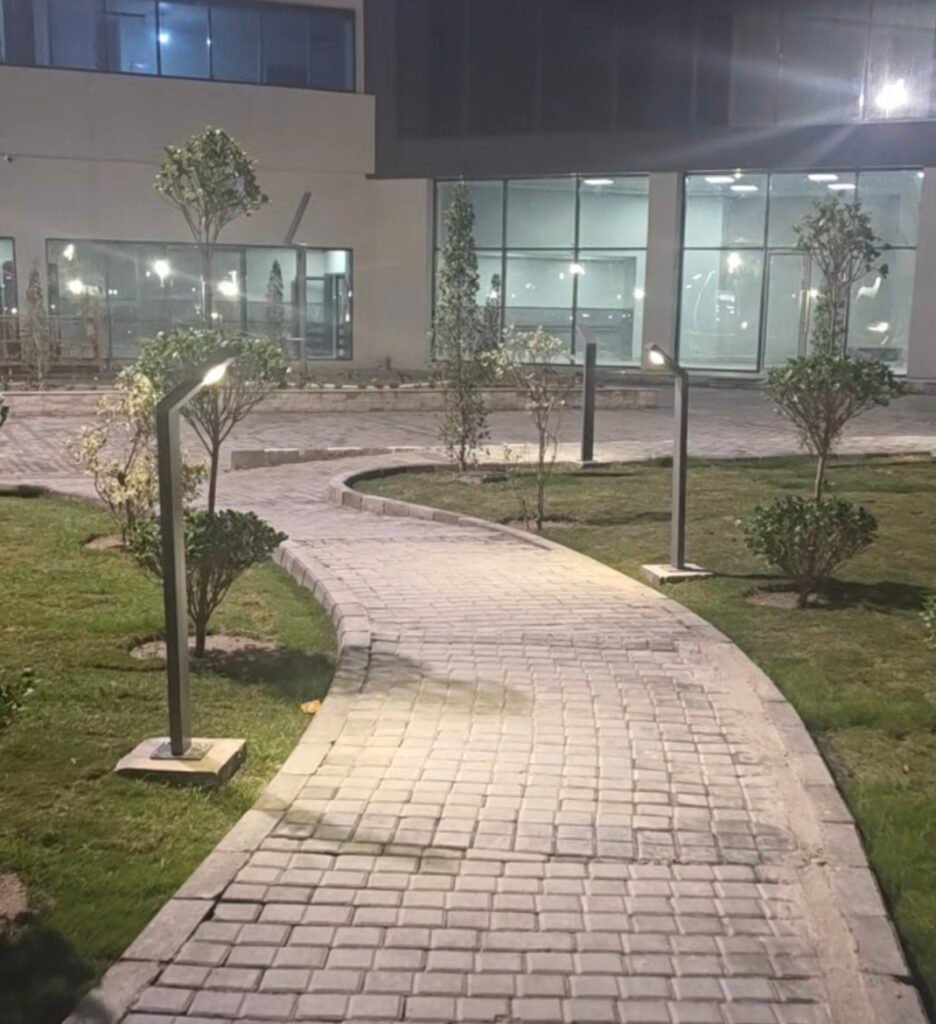
The images and video of the project are given below for more clarity and information.
Frequently Asked Questions — Historic and Institutional Facade Lighting Pakistan
How should facade lighting be designed for a historic building in Pakistan?
Use selective illumination — identify the most architecturally significant elements (columns, arches, portals, ornamental details) and illuminate only those, allowing less significant areas to remain in shadow. Match fixture type to element: beam lights for vertical columns, neon rope for curved arches, buried floor lights for wall grazing, spike lights for landscape trees. Use 3000K warm white throughout. Position all fixtures at ground level or within architectural recesses for daytime discretion.
What are beam lights and how are they used for column illumination?
Beam lights have a narrow 10°–25° beam angle that projects a precise column of light onto a specific architectural element. For facade columns, they are positioned at the base and angled upward — revealing height, proportion, and surface texture through grazing uplight. Newon supplies LED beam spot lights and LED beam lights for architectural column illumination.
What is neon rope light and why is it used for arch illumination?
LED neon rope light (neon flex) is a flexible LED tube producing a continuous smooth glow with no visible hotspots — flexible enough to follow any arch curve precisely. Installed within arch reveals, it creates a glowing outline that traces the arch geometry with warm light. Newon’s 360° round neon rope light is available online across Pakistan.
How do buried floor lights illuminate building walls?
Buried floor lights at wall base project upward grazing light that creates shadows in every surface irregularity — revealing the three-dimensional texture and material character of masonry walls. All ground-level buried fixtures must be IP67 rated per IEC 60529 for submersion resistance in Pakistan’s monsoon conditions.
Can Newon illuminate government and institutional buildings across Pakistan?
Yes. Newon has completed facade and landscape lighting for HIT Officers Mess Taxila, DHA Phase 2 mosques, World Bank Building Islamabad, Rashakai Special Economic Zone, and the Peshawar Museum and Sethi House under the KP Government KITE project. Contact us via WhatsApp or email info@newon.pk.
What colour temperature is correct for historic building facade lighting?
3000K warm white — recommended by the CIE and IES for heritage and historic architectural illumination. It complements aged stone, brick, and plaster finishes, creates a dignified atmosphere, and preserves the building’s warm material tones that cool white bleaches away.
About Newon — Pakistan’s Architectural and Heritage Lighting Specialists
Newon is Pakistan’s leading specialist in architectural, facade, and landscape lighting — headquartered at Haroon Plaza, Islamabad, with over 35 completed projects spanning government buildings, defence facilities, heritage structures, commercial plazas, mosques, hotels, and residential developments across Pakistan. The HIT Officers Mess project demonstrates Newon’s capability to deliver sensitive, architecturally considered lighting design for historic institutional buildings — a capability that extends across Pakistan’s rich portfolio of colonial-era, post-independence, and mid-century modern architecture.
Newon’s architectural facade lighting range includes LED facade lights, beam lights, neon rope lights, in-ground uplights, spike lights, and silicone profile lights — all available online at newon.pk with delivery across Pakistan. All products comply with NEECA Pakistan’s MEPS standards.
For architectural and heritage building lighting in the UAE and GCC, Newon operates newon.ae.
Ready to illuminate your building’s architectural character? Let’s talk.
📧 info@newon.pk
📞 +92 343 9227883
💬 WhatsApp: +92 343 9227883
📍 Office No 2, First Floor, Haroon Plaza, Islamabad, Pakistan
🌐 View our Facade Lighting Installation Service →