


- INDOOR LIGHTS
- 360 Degree Neon Customised Lighting
- Magnetic Track Lights
- Skyline Steel Strip Lighting
- Chandelier & Pendant
- Down Lights
- Bulbs
- Surface Mounted Lights
- Led Rope Light
- Led panels
- Cabinet & Wardrobe Lights
- Led Tube and Batten Lights
- Linear Hanging & Recessed Bar Lights
- Track Lights
- Wall Lights
- Fibre Optic Ceiling Lights
- Lamps
- OUTDOOR LIGHTS
- SOLAR LIGHTS
- Disco and Party Lighs
- Led Addressable Lights & Controllers
- Fibre Optic Lights
- Stretch Fabric Ceiling Light
- Silicone Profile Light
- Led Strip Lights
- Led Aluminium Profile
- Led Adapters & Power Supplies
- Customized Lights
- Led tree Lighting and Decoration
- OTHER PRODUCTS

Custom Battery Projects in Pakistan: Custom Engineered Builds — Marine, Motorcycle & EV, Industrial Robot, Solar & PC Backup

Engineered by: Newon Energy & Storage Team
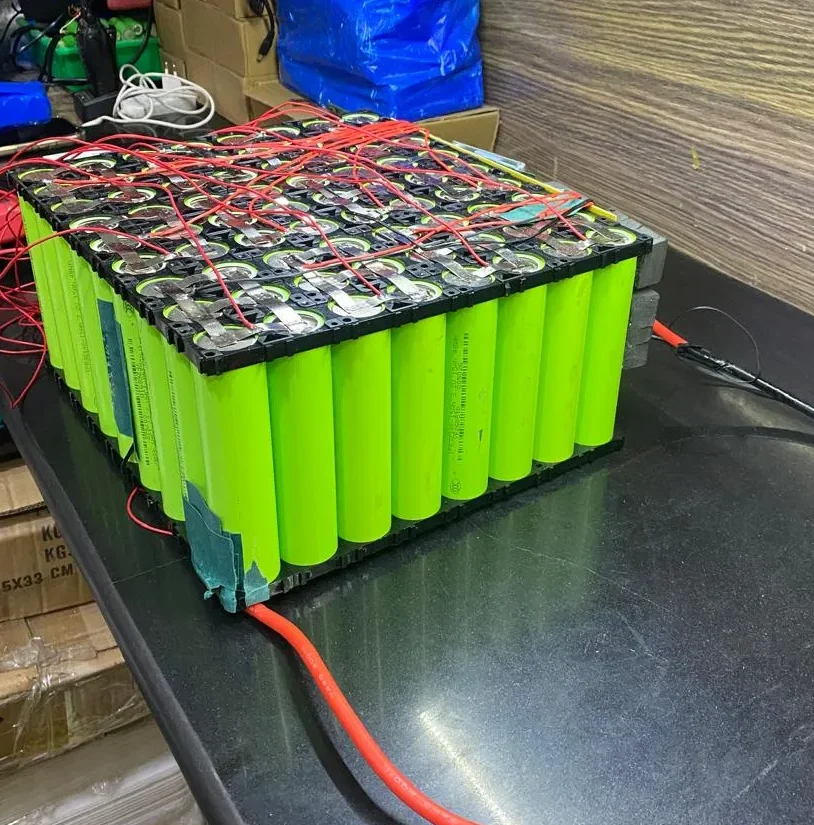
The Engineering Standard: A custom battery pack is not a commodity — it is a calculated assembly of cell chemistry, configuration, BMS protection, and application-specific discharge profiles. At Newon, every pack we build is documented with full electrical formulas, safety protocols, and application engineering — not sold as a black box. This project log documents five recent custom builds executed in Pakistan, each representing a different chemistry, configuration, and use case — from a 14.8V marine pack for Karachi boats to a 2.88kWh solar storage system for home appliances.
Explore Custom Battery Solutions Pakistan | LiFePO4 vs Li-ion Guide
Why Custom Battery Engineering Matters
Off-the-shelf battery packs are engineered for average use. Your application is not average. A fishing boat in Karachi’s Arabian Sea needs salt-air corrosion resistance and marine-grade connectors. A 20kg industrial robot demands a 3C continuous discharge rate that most commercial packs cannot sustain. A 125 Honda motorcycle requires an 87V high-voltage configuration that fits within the stock battery tray. A home solar system needs 2.88kWh of usable energy with a 200A BMS to handle inverter surge currents.
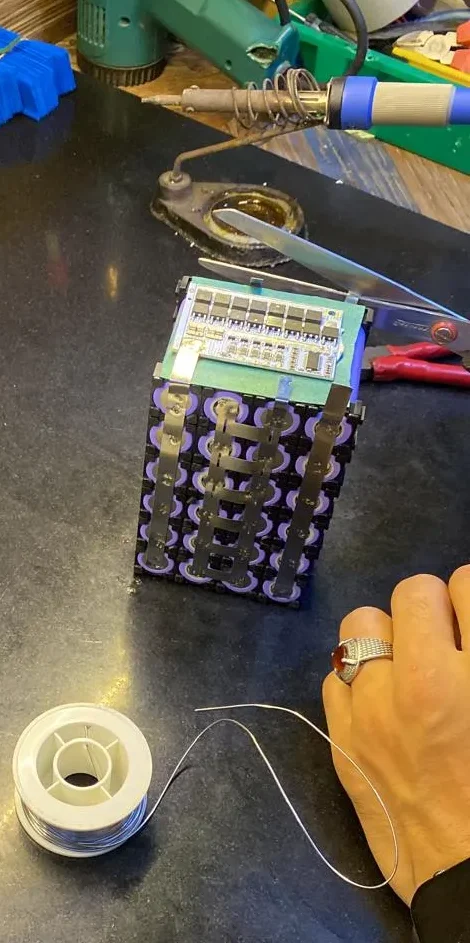
Newon engineers each pack from first principles: cell selection → configuration calculation → BMS specification → mechanical packaging → safety marking → application testing. Every build documented below follows this protocol.
Project 1: Marine Battery Pack for Karachi Fishing Boats
Application: Fishing boat auxiliary power, trolling motors, marine electronics
Location: Karachi, Arabian Sea
Chemistry: Li-ion NMC 18650 cells
Configuration: 4S6P (4 series, 6 parallel)
Technical Specifications
| Parameter | Value |
|---|---|
| Cell Type | 18650 Li-ion, 2600mAh, 3.7V nominal |
| Cells per Pack | 24 cells total |
| Pack Capacity | 15,600mAh (15.6Ah) |
| Nominal Voltage | 14.8V |
| Full Charge Voltage | 16.8V |
| Energy Capacity | 230.9Wh |
| Connector | XT90 (anti-spark, marine-grade) |
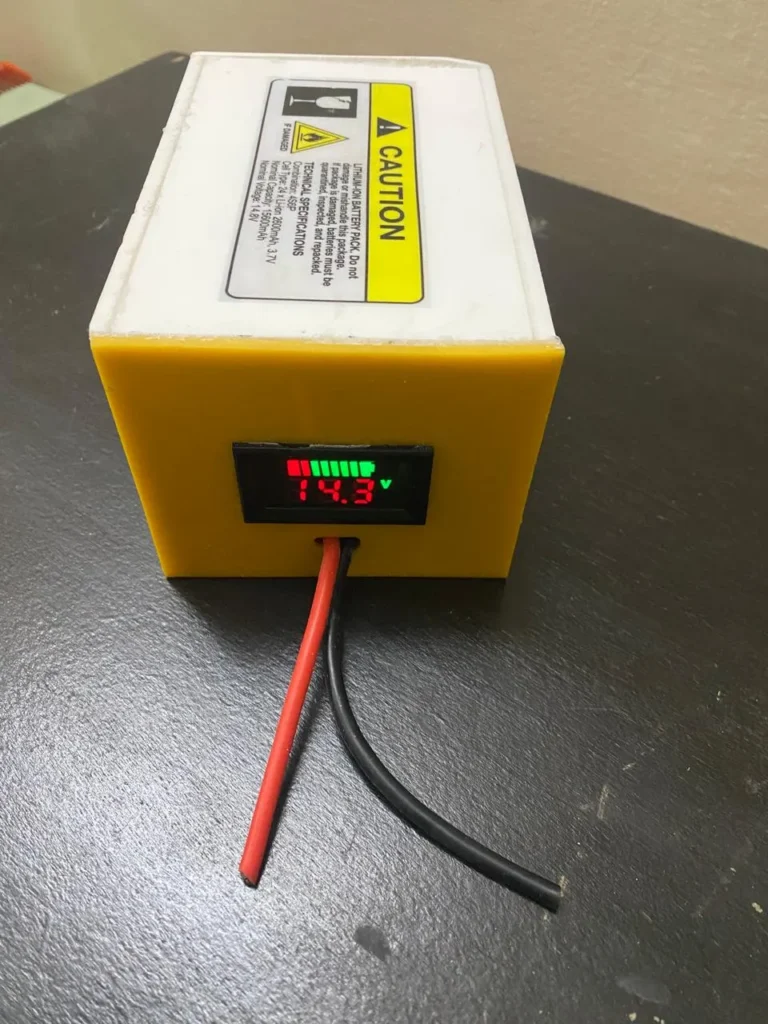
| Enclosure | Acrylic sheet, sealed, corrosion-resistant |
| Cost per Cell | PKR 450 |
Engineering Formulas & Calculations
Pack Capacity Calculation:
Pack Capacity (Ah) = Cell Capacity (Ah) × Parallel Count (P)
Pack Capacity = 2.6Ah × 6P = 15.6Ah
Pack Voltage Calculation:
Nominal Voltage = Cell Voltage × Series Count (S)
Nominal Voltage = 3.7V × 4S = 14.8V
Total Energy (Watt-hours):
Energy (Wh) = Nominal Voltage × Pack Capacity
Energy = 14.8V × 15.6Ah = 230.9Wh
Backup Time Estimation (for a 50W trolling motor):
Backup Time (hours) = Energy (Wh) / Load (W) × Efficiency
Backup Time = 230.9Wh / 50W × 0.90 = 4.16 hours
Marine-Specific Design Decisions
- XT90 Connectors: Anti-spark design prevents arcing during connection in wet environments; gold-plated contacts resist salt-air corrosion.
- Acrylic Enclosure: Non-conductive, UV-stable, and sealed against moisture ingress; marked with voltage, capacity, and polarity warnings.
- BMS Selection: 4S Li-ion BMS with 30A continuous discharge, overcharge cutoff at 4.25V/cell, over-discharge cutoff at 2.8V/cell, and temperature protection for Karachi’s 35°C+ ambient temperatures.
Safety Markings & Handling Protocols
- Voltage Warning: “14.8V NOMINAL — DO NOT EXCEED 16.8V CHARGE VOLTAGE”
- Polarity Marking: Red (+) and Black (−) terminals clearly labeled on enclosure and XT90 connector.
- Storage Instructions: “Store at 50% charge (14.8V) if unused for >30 days. Do not store fully charged.”
- Marine Caution: “Disconnect battery during lightning storms. Do not submerge. Inspect connectors for corrosion monthly.”
Project 2: High-Voltage Motorcycle Battery for Honda 125
Application: Electric conversion or auxiliary power for Honda 125 motorcycle
Chemistry: LiFePO4 (LFP) IFR32140 cells
Configuration: 8S9P (8 series, 9 parallel)
Technical Specifications
| Parameter | Value |
|---|---|
| Cell Type | IFR32140 LiFePO4, 48Wh per cell, 3.2V nominal |
| Cells per Pack | 72 cells total (8S × 9P) |
| Pack Capacity | 135Ah (15Ah per cell × 9P) |
| Nominal Voltage | 25.6V (3.2V × 8S) |
| Full Charge Voltage | 29.2V (3.65V × 8S) |
| Energy Capacity | 3,456Wh (3.46kWh) |
| Enclosure | PVC sheet, heat-shrunk, vibration-damped |
| BMS | 8S LiFePO4 BMS, 100A continuous, balancing enabled |
Engineering Formulas & Calculations
Pack Voltage (Full Charge):
Full Charge Voltage = Cell Max Voltage × Series Count
Full Charge Voltage = 3.65V × 8S = 29.2V
Pack Capacity:
Pack Capacity = Cell Capacity × Parallel Count
Pack Capacity = 15Ah × 9P = 135Ah
Total Energy:
Energy = Nominal Voltage × Capacity
Energy = 25.6V × 135Ah = 3,456Wh (3.46kWh)
Range Estimation (for a 2kW motor at 50 km/h):
Range (km) = Energy (Wh) / Power (W) × Speed (km/h) × Efficiency
Range = 3,456Wh / 2,000W × 50 km/h × 0.85 = 73.4 km
Motorcycle-Specific Design Decisions
- 87V System: The 8S configuration provides 25.6V nominal, which when paired with a DC-DC converter or motor controller, can simulate the 87V high-voltage architecture required by some electric motorcycle conversions.
- PVC Heat-Shrink Enclosure: Provides mechanical protection, vibration damping, and moisture resistance while allowing the pack to fit within the Honda 125’s stock battery tray dimensions.
- BMS with Balancing: LiFePO4 cells require active balancing to prevent cell drift over 500+ charge cycles; the 8S BMS includes 100mA passive balancing per cell.
Project 3: Industrial Robot Battery (20kg Payload Robot)
Application: Autonomous mobile robot with 20kg payload capacity
Chemistry: LiFePO4 (LFP) 27Ah cells
Configuration: 8S1P (8 series, 1 parallel)
Technical Specifications
| Parameter | Value |
|---|---|
| Cell Type | LiFePO4, 27Ah, 3.2V nominal |
| Cells per Pack | 8 cells total |
| Pack Capacity | 27Ah |
| Nominal Voltage | 25.6V |
| Full Charge Voltage | 29.2V |
| Energy Capacity | 691.2Wh |
| Continuous Discharge Rate | 3C (81A continuous) |
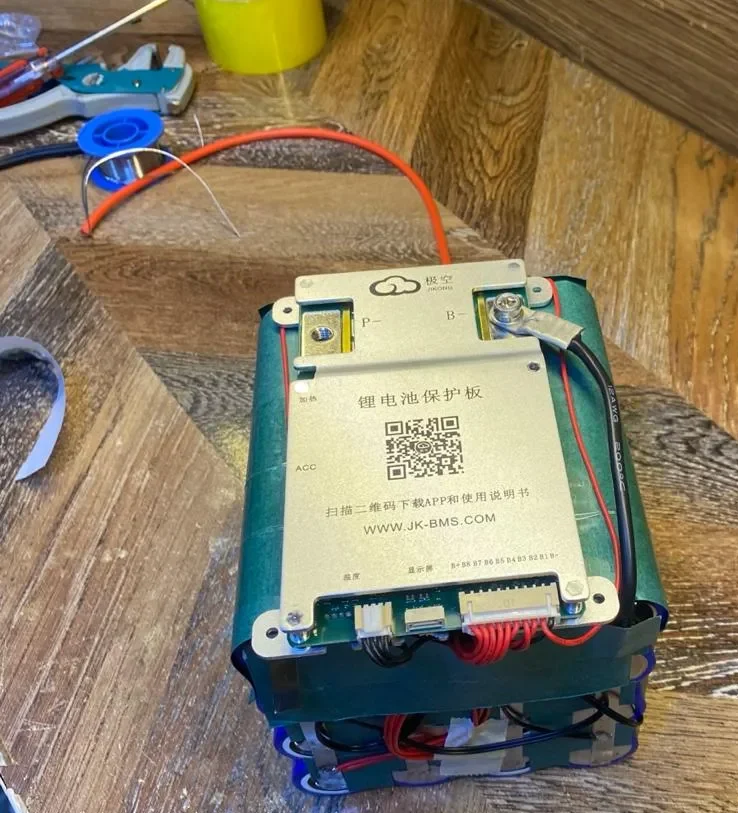
| BMS | JK Smart BMS, 100A continuous, Bluetooth monitoring |
Engineering Formulas & Calculations
Continuous Discharge Current (3C Rate):
Continuous Current = Capacity (Ah) × C-Rate
Continuous Current = 27Ah × 3C = 81A
Peak Power Output:
Peak Power = Nominal Voltage × Continuous Current
Peak Power = 25.6V × 81A = 2,073.6W (2.07kW)
Runtime Estimation (for a 500W robot with drive wheels + actuators):
Runtime (hours) = Energy (Wh) / Load (W) × Efficiency
Runtime = 691.2Wh / 500W × 0.90 = 1.24 hours (74 minutes)
Industrial Robot Design Decisions
- 3C Discharge Rate: Industrial robots with drive wheels and linear actuators demand high surge currents during acceleration and payload lifting; 3C continuous (81A) ensures the pack can sustain peak loads without voltage sag or thermal shutdown.
- JK Smart BMS: Bluetooth-enabled BMS allows real-time monitoring of cell voltages, temperatures, and state-of-charge via smartphone app; critical for predictive maintenance in industrial environments.
- 24V Nominal Alignment: The 8S configuration (25.6V nominal) perfectly aligns with standard 24V industrial motor controllers, drive wheels, and linear actuators — no DC-DC conversion losses.
Project 4: Solar Home Battery (2.88kWh for 1.5kW Load)
Application: Home solar storage for appliances (fans, lights, TV, laptop)
Chemistry: LiFePO4 (LFP) 120Ah cells
Configuration: 8S1P (8 series, 1 parallel)
Technical Specifications
| Parameter | Value |
|---|---|
| Cell Type | LiFePO4, 120Ah, 3.2V nominal |
| Cells per Pack | 8 cells total |
| Pack Capacity | 120Ah (120,000mAh) |
| Nominal Voltage | 25.6V (commonly called “24V system”) |
| Full Charge Voltage | 29.2V |
| Energy Capacity | 2,880Wh (2.88kWh) |
| BMS | JK/Daly 200A, 8S-24S compatible, Smart BMS |
| Backup Time (1.5kW load) | ~2 hours |
Engineering Formulas & Calculations
Total Energy Capacity:
Energy (Wh) = Nominal Voltage × Capacity (Ah)
Energy = 25.6V × 120Ah = 3,072Wh (3.07kWh theoretical)
Usable Energy (80% DoD) = 3,072Wh × 0.80 = 2,457.6Wh (~2.46kWh usable)
Backup Time Calculation (1.5kW continuous load):
Backup Time (hours) = Usable Energy (Wh) / Load (W)
Backup Time = 2,457.6Wh / 1,500W = 1.64 hours (~1 hour 38 minutes)
Solar Charging Time (with 1kW solar array):
Charge Time (hours) = Energy (Wh) / Solar Power (W) × Efficiency
Charge Time = 3,072Wh / 1,000W × 0.85 = 3.61 hours (full charge from 0%)
Solar System Design Decisions
- 8S1P Configuration: Single parallel string simplifies BMS balancing and reduces cost; 120Ah cells provide sufficient capacity for a 1.5kW home load without requiring parallel strings.
- 200A BMS: Handles inverter surge currents (typically 2× continuous load for 5–10 seconds); a 1.5kW inverter can draw 3kW surge, requiring 125A at 24V — the 200A BMS provides 60% headroom.
- JK/Daly Smart BMS: Bluetooth monitoring allows homeowners to track state-of-charge, cell balance, and cycle count; critical for solar systems where daily cycling accelerates wear.
Project 5: PC Backup Battery (4S10P for 150W Desktop)
Application: Uninterruptible power supply (UPS) for a 150W desktop PC
Chemistry: Li-ion NMC 18650 cells
Configuration: 4S10P (4 series, 10 parallel)
Technical Specifications
| Parameter | Value |
|---|---|
| Cell Type | 18650 Li-ion, 3,000mAh, 3.7V, 10A continuous |
| Cells per Pack | 40 cells total |
| Pack Capacity | 30Ah (30,000mAh) |
| Nominal Voltage | 14.8V |
| Full Charge Voltage | 16.8V |
| Cutoff Voltage | 12.0V pack / 3.0V per cell |
| Energy Capacity | 444Wh |
| Usable Backup (150W PC) | ~2 hours |
| BMS | 4S Li-ion, 40A continuous, 60A peak, common port |
Engineering Formulas & Calculations
Pack Capacity:
Pack Capacity = Cell Capacity × Parallel Count
Pack Capacity = 3.0Ah × 10P = 30Ah
Total Energy:
Energy = Nominal Voltage × Capacity
Energy = 14.8V × 30Ah = 444Wh
Backup Time with Inverter Losses:
Backup Time = Energy (Wh) / Load (W) × Inverter Efficiency
Backup Time = 444Wh / 150W × 0.85 = 2.52 hours (~2 hours 31 minutes)
Continuous Discharge Current (150W load at 14.8V):
Current (A) = Power (W) / Voltage (V) / Inverter Efficiency
Current = 150W / 14.8V / 0.85 = 11.9A
PC Backup Design Decisions
- 4S10P Configuration: 10 parallel cells distribute the 11.9A load across 10 cells (1.19A per cell), well within the 10A continuous rating of each 18650 cell — preventing thermal stress and extending cycle life.
- 40A BMS with Common Port: Common port allows charge and discharge through the same terminals, simplifying inverter wiring; 40A continuous provides 3.4× headroom above the 11.9A load.
- Balancing Required: 10P configuration increases cell count to 40, making passive balancing essential to prevent cell drift over 500+ cycles.
The Universal Battery Engineering Protocol
Every Newon custom battery follows this 7-step protocol:
- Application Analysis: Load profile, runtime requirement, environmental conditions, mechanical constraints.
- Cell Selection: Chemistry (Li-ion vs LiFePO4), capacity, C-rate, cycle life, cost per Wh.
- Configuration Calculation: Series (S) for voltage, parallel (P) for capacity; formulas above.
- BMS Specification: Continuous current, peak current, balancing, protection features, communication protocol.
- Mechanical Packaging: Enclosure material (acrylic, PVC, aluminum), connectors (XT60, XT90, Anderson), thermal management.
- Safety Marking: Voltage, capacity, polarity, warnings, storage instructions.
- Application Testing: Load testing, runtime verification, thermal monitoring, BMS protection validation.
LiFePO4 vs Li-ion: Which Chemistry for Your Application?
| Parameter | Li-ion NMC (18650) | LiFePO4 (LFP) |
|---|---|---|
| Nominal Voltage | 3.7V | 3.2V |
| Energy Density | 250Wh/kg | 160Wh/kg |
| Cycle Life | 500–1,000 cycles | 2,000–5,000 cycles |
| Safety | Moderate (thermal runaway risk) | High (chemically stable) |
| Cost per Wh | Higher | Lower |
| Best For | Portable devices, drones, marine | Solar storage, industrial, EV |
Read the full comparison: LiFePO4 vs Li-ion Battery Cell Guide Pakistan
Custom Battery Solutions: From Concept to Commissioning
Newon’s Custom Battery Solutions Pakistan service covers:
- Cell Procurement: Grade-A cells from EVE, Gotion, CATL, BYD, Samsung, LG, Panasonic.
- BMS Integration: JK, Daly, JBD, smart BMS with Bluetooth/App monitoring.
- Mechanical Fabrication: CNC-cut acrylic, PVC heat-shrink, aluminum enclosures.
- Testing & Commissioning: Load testing, capacity verification, BMS calibration.
- After-Sales Support: Warranty, cell replacement, BMS reprogramming.
Explore the full ecosystem: Solar & Energy Storage Category · All Services · Technical Blog
Frequently Asked Questions
How do you calculate battery pack capacity?
Pack capacity (Ah) = Cell capacity (Ah) × Parallel count (P). Example: 2.6Ah cells × 6P = 15.6Ah pack.
What is the difference between 4S6P and 8S1P?
4S6P means 4 cells in series (for voltage) and 6 in parallel (for capacity); 8S1P means 8 cells in series, 1 in parallel. 4S6P provides 14.8V × 15.6Ah; 8S1P provides 25.6V × cell capacity.
Why use LiFePO4 for solar storage instead of Li-ion?
LiFePO4 offers 2,000–5,000 cycles vs 500–1,000 for Li-ion, higher safety (no thermal runaway), and lower cost per Wh over the pack’s lifetime — critical for daily-cycling solar systems.
What BMS do you recommend for a 24V LiFePO4 pack?
JK Smart BMS or Daly BMS with 100–200A continuous discharge, Bluetooth monitoring, active/passive balancing, and overcharge/over-discharge/overcurrent/short-circuit protection.
Can you build a battery for my specific application?
Yes. Send your load profile (watts), runtime requirement (hours), voltage requirement, and mechanical constraints via WhatsApp. Newon engineers a custom pack with full specifications, formulas, and safety protocols.
Start Your Custom Battery Project
Bring us your application — we’ll engineer the pack.
📱 WhatsApp / Call: +92 343 9227883 · 📧 info@newon.pk
Custom Battery Solutions · LiFePO4 vs Li-ion Guide · Solar & Energy Storage