


- INDOOR LIGHTS
- 360 Degree Neon Customised Lighting
- Magnetic Track Lights
- Skyline Steel Strip Lighting
- Chandelier & Pendant
- Down Lights
- Bulbs
- Surface Mounted Lights
- Led Rope Light
- Led panels
- Cabinet & Wardrobe Lights
- Led Tube and Batten Lights
- Linear Hanging & Recessed Bar Lights
- Track Lights
- Wall Lights
- Fibre Optic Ceiling Lights
- Lamps
- OUTDOOR LIGHTS
- SOLAR LIGHTS
- Disco and Party Lighs
- Led Addressable Lights & Controllers
- Fibre Optic Lights
- Stretch Fabric Ceiling Light
- Silicone Profile Light
- Led Strip Lights
- Led Aluminium Profile
- Led Adapters & Power Supplies
- Customized Lights
- Led tree Lighting and Decoration
- OTHER PRODUCTS

Architectural lighting, Bridge Lighting, Facade Lighting, Mosque Lighting, Outdoor Lighting, Project
Heritage Lighting Pakistan: Ranbir Singh Baradari Illumination in Muzaffarabad

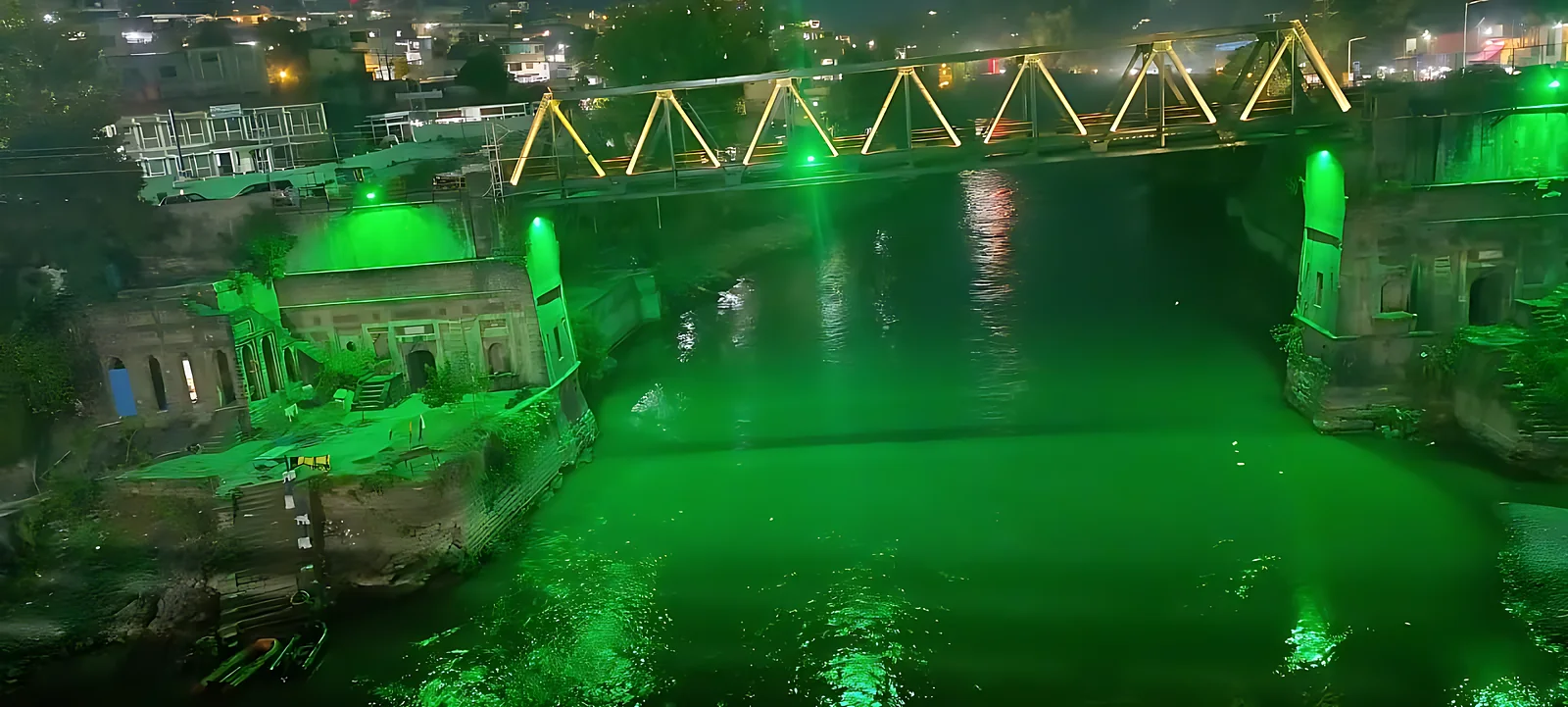
Project documentation: Newon Design & Technical Team Reading time: 8 minutes | Sector: Heritage preservation / tourism / architectural facade lighting Location: Ranbir Singh Baradari, Muzaffarabad, AJK Pakistan
Heritage, preserved in light. The Ranbir Singh Baradari — a double-story royal pavilion built by Maharaja Ranbir Singh in the 19th century (circa 1885), where rulers and guests once gathered to relax and appreciate the cool river breeze — now stands illuminated at the exact point where the Neelum River blends into the waters of the Jhelum.
This modern preservation and beautification effort was executed by Newon Lighting Pakistan under the collaborative supervision of the National Highway Authority (NHA) team and the Commissioner of Muzaffarabad, using 100W RGB architectural flood lighting to respectfully reveal a landmark of deep historical and geographical importance to residents and visiting tourists alike.
View Newon Project Portfolio | Discuss a Heritage Lighting Project | WhatsApp Newon Technical Team
Project Snapshot: Ranbir Singh Baradari, Muzaffarabad
| Project Element | Detail |
|---|---|
| Landmark | Ranbir Singh Baradari, Muzaffarabad |
| Heritage context | Double-story royal pavilion, built circa 1885 by Maharaja Ranbir Singh |
| Original function | A gathering pavilion where rulers and guests relaxed and enjoyed the river breeze |
| Location significance | Sits exactly where the Neelum River blends into the Jhelum — a site of deep historical and geographical importance |
| Sector | Heritage preservation / tourism / architectural facade lighting |
| Client / stakeholder collaboration | NHA team, with the Commissioner of Muzaffarabad |
| Lighting objective | Preservation and beautification — reveal the pavilion’s architecture after dark while honouring its royal heritage |
| Primary lighting layer | RGB architectural flood lighting |
| Fixtures used | 100W RGB flood lights (quantity to be confirmed) |
| Newon scope | Heritage lighting concept, architectural flood layout, colour-scene strategy, installation coordination and commissioning support |
| Outcome | A 19th-century royal pavilion transformed into a glowing riverscape landmark at the Neelum–Jhelum confluence |
What Is a Baradari? (And Why It Matters for Lighting Design)
A Baradari is, by definition, an open pavilion — traditionally built with multiple doors and arched openings on each side to invite cross-ventilation and capture the breeze. The Ranbir Singh Baradari follows this logic: a double-story royal pavilion designed so that rulers and guests could gather, relax, and appreciate the cool river breeze at the confluence of the Neelum and Jhelum.
For a lighting designer, that original purpose is the brief. A Baradari is meant to be experienced as an open, breathable structure — its charm lies in its openings, its storeys, its roofline, and its relationship to the water. Heritage lighting here must therefore reveal the pavilion’s form and openness, not seal it under a flat, uniform wash. The 100W RGB architectural flood lighting is used to sculpt the elevation and roofline so the building reads as a dignified, three-dimensional landmark after dark.
Why Heritage Lighting Pakistan Needs Landmark-Specific Design
The Ranbir Singh Baradari is not just an old building. It is a historical monument, a geographical marker at a major river confluence, and a tourism asset for Muzaffarabad. Lighting a heritage pavilion demands a different approach from lighting a commercial facade:
- Reveal the architecture — make the double-story form, the openings, and the roofline legible at night without flattening the structure.
- Honour the heritage — avoid visual noise, excessive brightness, or colour that disrespects a royal 1880s landmark.
- Serve preservation and beautification — the lighting is a visibility and placemaking tool that enhances how the landmark is experienced after dark, while structural conservation remains a separate discipline.
- Create destination value — give residents, tourists, and photographers a reason to experience the confluence at night.
Newon’s approach was a single, disciplined architectural RGB flood layer that sculpts the pavilion and provides flexible colour scenes for civic and tourism moments.
Lighting Categories Applied in This Project
This project spans multiple Newon capability verticals — it is heritage, facade, architectural, and tourism lighting in one installation:
| Lighting Type | How It Applies to the Ranbir Singh Baradari |
|---|---|
| Heritage lighting | Reveals a 19th-century royal pavilion respectfully after dark, honouring its historical character. |
| Preservation & beautification lighting | Enhances visibility and public appreciation of the landmark as a modern conservation-adjacent effort. |
| Architectural facade lighting | Uses directed flood light to model the pavilion’s elevation, storeys, openings and roofline. |
| RGB flood lighting | Provides 100W colour-capable fixtures for civic, festive and tourism scenes. |
| Dynamic / colour-change lighting | Allows the landmark to shift beyond a single static appearance for events and city branding. |
| Cultural landmark illumination | Treats the Baradari as a site of historical and geographical importance for residents and tourists. |
| Riverscape lighting | Responds to the pavilion’s setting at the Neelum–Jhelum confluence, where reflection and viewpoint matter. |
| Tourism night lighting | Turns the heritage site into an evening destination and photography point. |
| Civic / event lighting | Lets the landmark participate in seasonal or city-level night celebrations. |
| Public infrastructure coordination | Aligns with NHA and civic stakeholders for safe, maintainable installation. |
The Lighting Strategy: RGB Architectural Flood Lighting on a Royal Pavilion
The documented installation uses 100W RGB flood lights as the architectural layer. On a heritage pavilion, RGB flood lighting does two jobs at once:
1. Sculpt the form. Positioned to wash and graze the elevation, the flood lights model the double-story mass, the arched openings, and the roofline — giving the Baradari depth and a readable silhouette against the night sky and the river beyond, rather than a flat, over-lit face.
2. Provide a flexible colour identity. Because the fixtures are RGB, the landmark is not locked to one look. The system can hold a dignified, restrained tone for everyday heritage presentation and shift to colour scenes for civic occasions, festivals, and tourism moments — without re-fixture-ing the building.
This is the heritage discipline Newon applies on landmarks: the architecture leads, the colour supports. The pavilion’s 1885 character stays legible; the RGB layer adds civic life after dark.
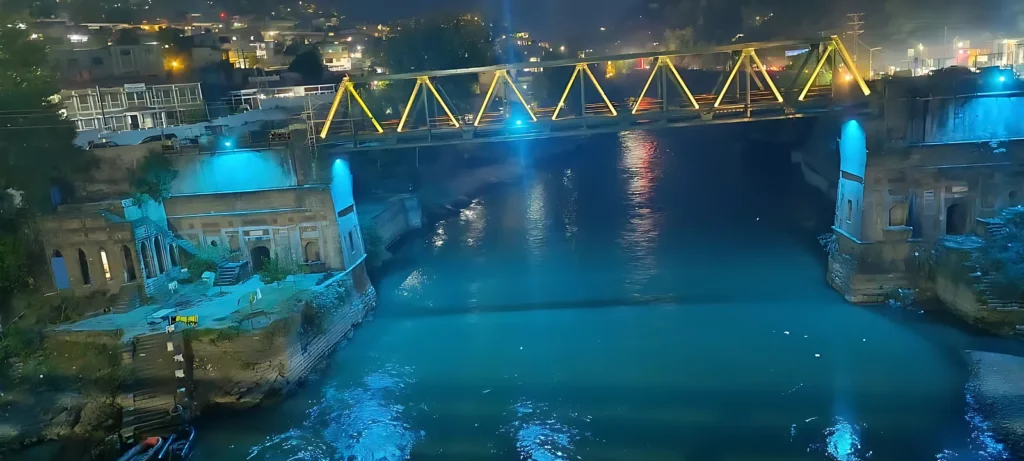
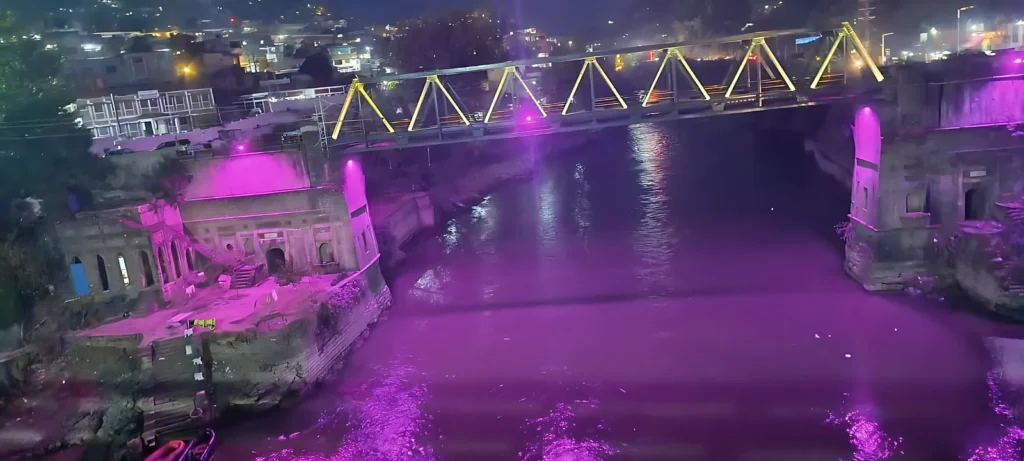
See the Ranbir Singh Baradari heritage lighting project in action across Newon’s official channels — from the Facebook project post and the TikTok night reveal, to the LinkedIn project update, the Instagram post, and the full Newon LinkedIn company feed — each capturing how Newon Lighting Pakistan, under the collaborative supervision of the NHA team and the Commissioner of Muzaffarabad, used 100W RGB architectural flood lighting to preserve, beautify, and respectfully illuminate this 1885 double-story royal pavilion at the Neelum–Jhelum confluence, turning a heritage landmark into a vibrant tourism destination after dark.
Heritage-Sensitive Design Principles Used
Newon’s facade approach for the Ranbir Singh Baradari follows heritage lighting principles:
1. Reveal, Do Not Blind
A heritage pavilion should be read through contrast, shadow, and the play of light across its openings and storeys. Uniform flooding flattens character; controlled flood modeling preserves it.
2. Respect the River Context
The Baradari sits at the Neelum–Jhelum confluence. The design limits upward spill and uncontrolled brightness so the landmark glows as a structure within the riverscape, not against it.
3. Separate Preservation from Beautification
Lighting here is a visibility and beautification tool that enhances public appreciation and night identity. Physical/structural conservation of the 1885 fabric is a separate workstream and is not implied by the lighting scope.
4. Design for Viewpoints
A confluence pavilion is seen from the riverbank, the approach routes, the water, and tourism photography positions. The flood layout considers how the double-story form reads from each.
5. Avoid Harm to Historic Fabric
Mounting, wiring, and heat are planned so fixtures and cables do not damage or stress the heritage structure — a non-negotiable on a landmark of this age.
6. Plan for Maintenance
Public heritage lighting must stay reliable and visually consistent. Access, cleaning, re-aiming, and driver checks are planned from the outset.
Preservation and Beautification: The Dual Mandate
You framed this project as a modern preservation and beautification effort — and that dual mandate is exactly how heritage lighting should be positioned to authorities and the public:
- Preservation dimension: by making the landmark visible, legible, and valued after dark, the lighting strengthens public connection to the 1885 pavilion and supports its ongoing cultural relevance.
- Beautification dimension: the RGB architectural flood layer gives Muzaffarabad a polished, vibrant riverscape focal point at the confluence — a night identity that serves tourism, civic pride, and events.
Newon’s role is to deliver the lighting that achieves both, respectfully and maintainably, in coordination with the NHA team and the Commissioner of Muzaffarabad.
Collaboration with NHA and the Commissioner of Muzaffarabad
This project was executed by Newon Lighting Pakistan under the collaborative supervision of the National Highway Authority (NHA) team and the Commissioner of Muzaffarabad.
For heritage and public-landmark lighting, collaboration is not optional. It coordinates across structural safety, public access, viewpoint and glare control, cable routing and protection, weatherproofing, maintenance access, tourism impact, and civic approvals. Newon translates these constraints into a lighting design that is both beautiful and practical.
Technical Fixture Summary
| Layer | Fixture Type | Wattage | Quantity | Lighting Role |
|---|---|---|---|---|
| Architectural flood / colour | RGB flood light | 100W | to be confirmed | Model the pavilion elevation, storeys and roofline; provide civic/tourism colour scenes |
The Muzaffarabad Heritage Night Corridor
The Ranbir Singh Baradari and the Domel Truss Bridge both sit at the Neelum–Jhelum confluence in Muzaffarabad. Lit as a coordinated pair, they form a heritage night corridor — a pavilion and a bridge glowing at the same historic river meeting point — that gives the city a coherent after-dark identity and gives Newon a connected heritage portfolio.
- See the sibling project: Domel Truss Bridge Heritage Facade Lighting, Muzaffarabad — warm-white 5° beam accents on the 1880s steel truss plus RGB flood lighting.
- Together these projects demonstrate Newon’s range across heritage pavilion facade lighting and heritage bridge/structural illumination at the same landmark confluence.
Newon’s Wider Lighting Capabilities
The Ranbir Singh Baradari project demonstrates Newon’s ability to handle lighting beyond homes, retail, and offices. It connects directly to several Newon service verticals:
- Heritage and preservation lighting
- Architectural facade lighting for landmarks
- RGB dynamic / colour-change lighting
- Cultural and tourism illumination
- Public infrastructure and civic project coordination
- Outdoor flood and accent lighting
- Installation planning, commissioning, and after-sales support
This is the kind of work that builds authority with government departments, tourism stakeholders, municipal bodies, heritage custodians, and infrastructure consultants.
Maintenance and Long-Term Care for Heritage Flood Lighting
A heritage landmark lighting system must remain reliable, safe, and visually consistent. Newon’s handover approach for this format includes:
- Fixture aiming records — so any displaced flood unit can be restored to the designed angle on the elevation.
- Wiring route documentation — especially important where cables meet historic fabric and riverfront exposure.
- Access plan — safe maintenance paths for cleaning, inspection, and driver checks without stressing the structure.
- Spare-part strategy — matching 100W RGB flood units for future replacement.
- Control testing — verification of default tone, colour scenes, timers, and manual fallback.
- Seasonal inspection — check for corrosion, loose mounts, water ingress, cable abrasion, and dust build-up at the confluence.
- Heritage-safe cleaning — avoid abrasive methods on the pavilion’s historic surfaces.
For public landmarks, maintenance is part of the lighting design — not an afterthought.
Tourism and Civic Impact: A Landmark That Glows at the Confluence
Muzaffarabad is known for its rivers, mountains, and historical character. The Ranbir Singh Baradari is a natural photography point, a civic landmark, and a symbol of the city’s riverine identity at the Neelum–Jhelum meeting point.
When a heritage pavilion is lit well, it creates tourism value:
- Visitors stay longer after sunset and experience the confluence at night.
- Photographers and content creators capture the landmark and the riverscape.
- Local businesses benefit from increased evening movement.
- City identity strengthens after dark.
- Historical structures gain public affection and visibility.
- Seasonal and civic events gain a visual centrepiece.
The lighting does not merely make the Baradari visible. It makes it memorable — and pairs with the Domel Truss Bridge to define a heritage night corridor at the confluence.
Frequently Asked Questions
What is heritage lighting?
Heritage lighting is exterior architectural lighting designed to reveal a historic structure after dark without damaging it. On the Ranbir Singh Baradari, Newon used 100W RGB architectural flood lighting to model the 1885 double-story royal pavilion at the Neelum–Jhelum confluence, balancing preservation with beautification.
What is a Baradari?
A Baradari is an open pavilion traditionally built with multiple doors and arched openings to invite cross-ventilation and capture the breeze. The Ranbir Singh Baradari is a double-story royal pavilion where rulers and guests once gathered to relax and enjoy the cool river breeze at the confluence.
Why use RGB flood lighting on a heritage pavilion?
RGB flood lighting lets a landmark be sculpted architecturally by day-neutral tones and activated by colour for civic, festive, and tourism scenes — without re-fixturing the building. On heritage structures the discipline is to let the architecture lead and the colour support, keeping the 1885 character legible.
Did Newon work with NHA and the Commissioner of Muzaffarabad?
Yes. The project was executed by Newon Lighting Pakistan under the collaborative supervision of the NHA team and the Commissioner of Muzaffarabad. Public-landmark lighting coordinates structural safety, access, glare control, cable routing, maintenance, and civic approvals before installation.
Is lighting the same as conserving the building?
No. The lighting here is a preservation-adjacent beautification and visibility effort that strengthens public connection to the landmark after dark. Physical or structural conservation of the 1885 fabric is a separate workstream and is not implied by the lighting scope.
What maintenance does heritage flood lighting need?
Planned access for cleaning, re-aiming, driver checks and cable inspection; fixtures mounted so they do not stress historic fabric; wiring protected from river spray and weather; a handover file with as-built routes, spare parts, and warranty terms.
Newon’s Process for Heritage Building Lighting Projects
- Landmark and history study — understand the structure, its original purpose, and its public context.
- Stakeholder coordination — align with NHA, municipal/civic authorities, and heritage custodians.
- Lighting concept design — define the architectural flood layer, colour strategy, glare and spill limits.
- Fixture selection — choose wattage, RGB capability, mounting, and protection level for the fabric.
- Structural and electrical planning — confirm safe, fabric-preserving mounting, cable routes, and access.
- Viewpoint mock-up / aiming plan — verify how the pavilion reads from key public and photography positions.
- Installation supervision — coordinate with civil, electrical, and heritage requirements.
- Commissioning — test default tone, colour scenes, controls, timers, and manual fallback.
- Handover and maintenance plan — as-built documentation, spare-part guidance, and service recommendations.
Relevant Newon Capabilities
- Contact Newon for a Project Consultation — government, tourism, heritage, and infrastructure enquiries.
- Sibling heritage project: Domel Truss Bridge, Muzaffarabad
- WhatsApp: +92 343 9227883
Start a Heritage, Facade, or Landmark Lighting Project with Newon
If you are planning a heritage pavilion, monument, bridge, government building, museum, hotel facade, or tourism asset lighting project, Newon can design and execute the lighting with architectural precision and heritage respect.
📱 WhatsApp / Call: +92 343 9227883 📧 Email: info@newon.pk 📍 Office: Islamabad, Pakistan — serving nationwide heritage, commercial, residential, and infrastructure lighting projects.